Loggerhead turtle released back into ocean after surviving 10-pound tumor removal
Nicknamed “Molly,” the turtle beat all odds and survived the hourslong surgery and months of recovery after the tumor threatened her life.
A 170-pound loggerhead turtle nicknamed “Molly” was back home in the warm waters of the Florida Keys on Tuesday after a successful surgery to remove a life-threatening tumor inches from her head and months of recovery that have gone viral on social media.
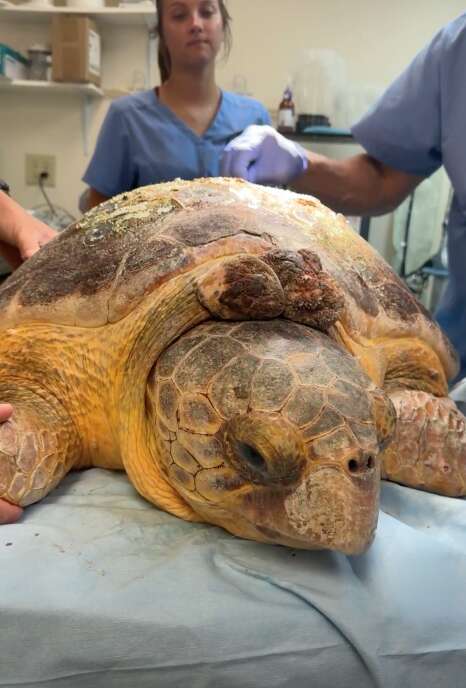
In August, a charter fisherman found Molly, an approximately 25- to 30-year-old loggerhead, trapped by commercial fishing lines tethering her to a crab trap. The fisherman noticed the lines were tangled around an enormous tumor near the left side of Molly’s head.
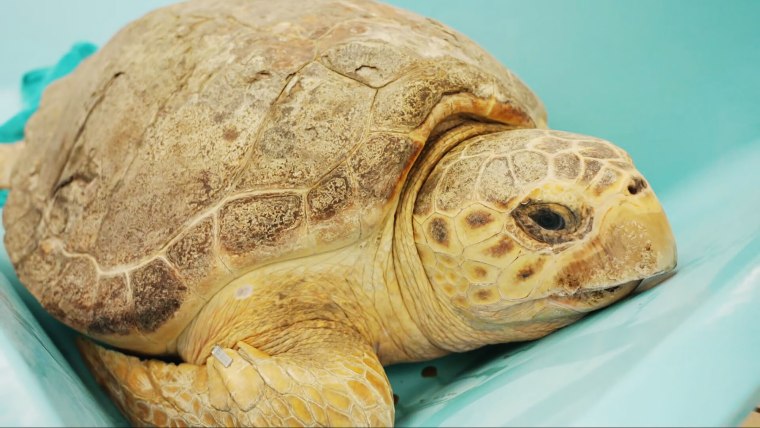
Molly after her surgery.Juliette Arcodia / NBC News
“She had multiple tumors, but that 10.1-pound tumor is what was really threatening her life,” said Bette Zirkelbach, manager of The Turtle Hospital, a small nonprofit organization working to rehabilitate endangered sea turtles in Marathon, Florida.
“It was taking all her good blood, and she was anemic when she came in” Zirkelbach said. Once she was admitted, Molly received fluid treatment, antibiotics, vitamins and a pressure wrap on the large tumor to control bleeding.
Molly underwent a three-hour operation to remove the tumor. Zirkelbach said it’s the largest tumor ever successfully removed, and after Molly tested with proper bloodwork, she was ready to return home.

Molly and her tumor before surgery at The Turtle Hospital.The Turtle Hospital
Hours before she was set to be released into the ocean, Molly was fitted with a satellite tracking device, which will allow the hospital and the public to track her recovery and journey. The trackers from the Sea Turtle Conservancy cost roughly $5,000 and are attached via nonheat epoxy to “glue” the bottom of the transmitter to the turtle’s shell. The goal is for the tracker to remain attached for six months to two years.
Molly’s tracker was fixed to her shell, and then she was transported via “turtle ambulance” to Higgs Beach in Key West, where a crowd of more than 100 people waited to see her final steps on sand. She was carried to the edge of the water, and then once on the sand, she immediately headed into the ocean and swam away.
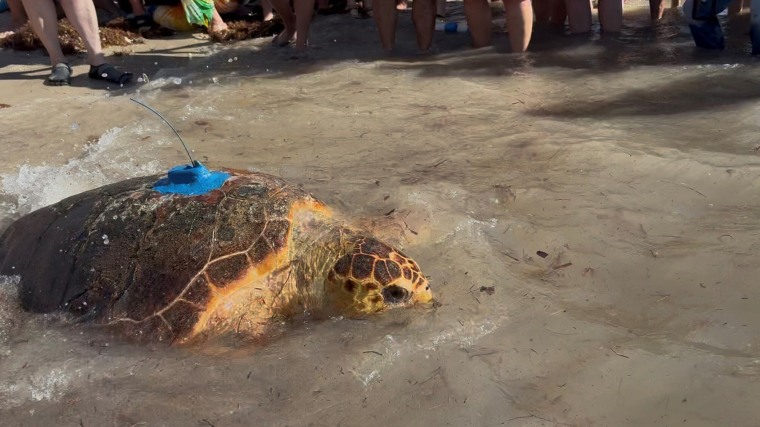
Molly swims away with a tracker attached to her back.Juliette Arcodia / NBC News
Tristan and Tori Edsel were visiting from Columbia, South Carolina, and made the trip to the beach to see Molly’s release. “I think she beat all odds with the tumor … and then she successfully got to go back to where she’s from, the ocean,” Tristan Edsel said.
Zirkelbach reflected on the turtle’s long journey: “Molly has helped so many people around the world fall in love with sea turtles. … She beat the odds.”
Rescuers Pry Barnacles Off Sea Turtle, Giving Her A Life-Changing Makeover
Now she’s lighter, feistier and healthier.
At first glance, Molly looks like any other loggerhead sea turtle, her reddish-brown shell moving gracefully through the water as she pops her nose up for air. But just two weeks ago, Molly arrived at The Turtle Hospital in south Florida covered in barnacles and rare tumors.
“She was quiet when she came in,” Bette Zirkelbach, general manager at The Turtle Hospital, told The Dodo. “It was really bad.”
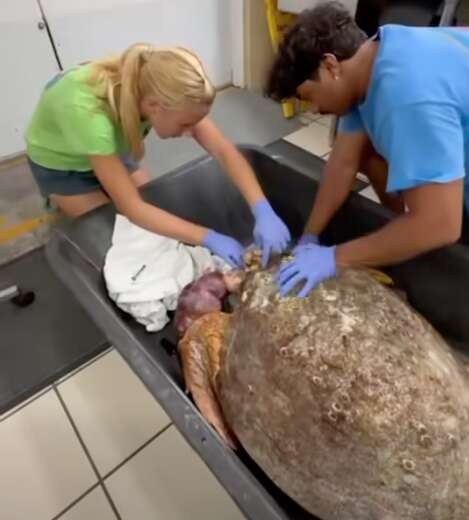
The Turtle Hospital
A charter fisherman had spotted Molly, whom Zirkelbach estimates is 25 to 30 years old, off the coast of an island in the Florida Keys. Commercial fishing lines were wrapped around her body, tethering her to a crab trap.
Notably, the lines were tangled around an enormous tumor near the left side of Molly’s head.
“One of the largest tumors we’ve ever seen!” The Turtle Hospital wrote in a Facebook post about Molly’s arrival at their facility. Zirkelbach said a viral disease called fibropapillomatosis (FP) causes tumors, but it’s rare among loggerheads. She’s only seen two other cases in her whole career.
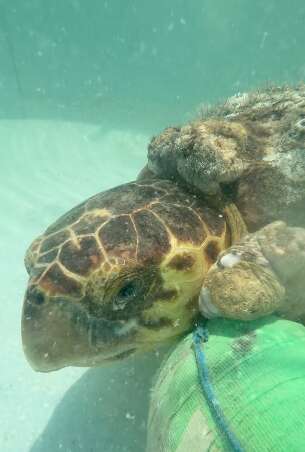
The Turtle Hospital
Staff met the fisherman at a dock and safely rushed Molly to The Turtle Hospital, where they disentangled her from the fishing line. The ailing turtle received fluids and antibiotics as staff wrapped her tumor and immediately flew in a vet who could remove it.
Right now, researchers from around the world agree the best treatment for FP is removing the tumors and helping the turtle build back their immune system. Zirkelbach said her clinic is getting ready to participate in a study to better understand how to treat FP, which is more common in green sea turtles.
For Molly, surgery to remove her 10-pound tumor took three hours. She handled it like a champ and must have felt a bit lighter afterwards.
The Turtle Hospital
After going through so much trauma, staff waited for Molly to gain some strength back before tackling the barnacles crusted onto her shell.
Zirkelbach said that barnacles, tiny crustaceans that latch onto sea turtles for free rides to more food, aren’t necessarily harmful to turtles, but too many can slow turtles down or cause infections if they burrow into skin.
Removing barnacles from Molly was part of her healing process. She sat patiently as The Turtle Hospital team pried barnacle after barnacle off her shell. Then staff brushed her off, hosed her down and slathered her with antimicrobial cream. Molly essentially got the full spa treatment.
The Turtle Hospital
As they slipped her back into her hospital tank, Molly immediately paddled around, the water gliding over her smooth shell.
“She is biting and feisty now, which is really good to see,” Zirkelbach said. “She’s harder to work with, but that’s showing she’s fighting and strong, which is normal for loggerhead sea turtles.”
The Turtle Hospital
Molly continues to heal nicely and gets stronger every day — she even gets the zoomies. There’s no sign of internal tumors, and her vet checkups have gone swimmingly.
Zirkelbach is hopeful that her team will be able to release the “Marvelous Miss Molly” back into the ocean, where she belongs.