“If Diogo Jota Were Still Here, It Would Be Different”: The Portugal Loss That Made the Football World Remember a Missing Warrior
ARLINGTON, Texas — The final whistle had already blown. The scoreboard at Dallas Stadium showed the reality Portugal did not want to accept: Spain had survived, Portugal had fallen, and another World Cup dream had disappeared in the space between one goal and one painful night.
But as the Portuguese players walked away from the pitch, as fans in red and green remained silent in the stands, the conversation quickly moved beyond tactics, formations and missed chances.
One name kept returning.
Diogo Jota.
For many watching Portugal’s 1–0 defeat to Spain in the 2026 FIFA World Cup Round of 16, the absence of Jota felt larger than a single missing player. It represented something impossible to measure — the loss of a footballer whose greatest qualities were often invisible until the biggest moments arrived.
And after the match, former Liverpool manager Jürgen Klopp was asked about Portugal’s elimination. His response, filled with emotion and reflection, brought back memories of the player he once trusted at Anfield.
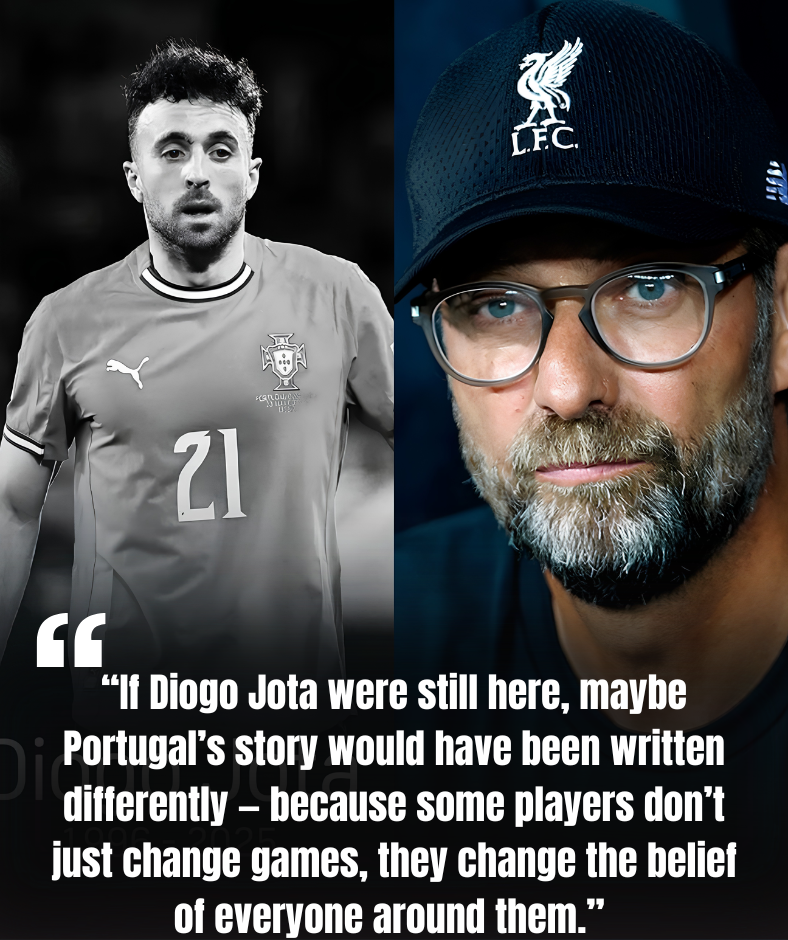
“If Diogo Jota were still here, it would be different,” Klopp said.
Not because one player alone could guarantee victory. Not because football can be rewritten by imagination. But because some players change the feeling of a team simply by being present.
“I know football is about what happens on the pitch, about the decisive moments,” Klopp reflected. “But sometimes football also makes you think about the things that can no longer happen.”

Jota was never the loudest personality in the dressing room. He was not the type of player who demanded attention before a match or searched for the spotlight after one. His influence came differently.
It came through movement.
Through intelligence.
Through the belief that every second of a match mattered.
During his years under Klopp at Liverpool, Jota became known as one of the most unpredictable attackers in Europe. He could disappear from a defender’s view for a moment, then appear exactly where the danger was. He understood space. He understood timing. Most importantly, he understood pressure.
“When the team needed something special, Diogo was the kind of player who could create that moment,” Klopp said.
That was the quality Portugal missed against Spain.
The match was decided by the smallest margins — the kind of margins that define World Cups. Portugal competed, defended with discipline and searched for opportunities, but Spain controlled the rhythm and found the breakthrough that ended their tournament.
Portugal had experience. They had talent. They had players capable of changing games.
But football is sometimes about having one more person who can turn uncertainty into belief.
That was Jota.
“If he was still wearing the Portugal shirt, still making those runs, still fighting for every ball like it was the last one, maybe the story would have been different,” Klopp said.
The word “maybe” matters.
Because even Klopp understands the truth of football: no player can promise a result. No absence can fully explain a defeat. Spain deserved credit for their performance, and Portugal’s elimination cannot be reduced to one missing name.
But Jota represented something deeper than statistics.
There are players remembered because of trophies. There are players remembered because of records. And then there are players remembered because their teammates feel stronger when they are standing beside them.
Jota belonged to that final category.
For Portugal, he was more than a forward. He was a fighter. A player who pressed defenders, chased lost causes and played every match with an intensity that teammates could feel.
For Liverpool, he was more than a signing. He became part of a generation that brought unforgettable nights and unforgettable emotions.
For Klopp, he was more than a footballer he coached.
He was someone he believed in.
“When you work with players like Diogo, you understand that football is not only about what they give you during ninety minutes,” Klopp said. “It is about the person they are, the energy they bring, and the memories they leave behind.”
As Portugal left the World Cup, the question remained impossible to answer:
What if Diogo Jota had been there?
Maybe he would have scored.
Maybe he would have created the moment Portugal needed.
Maybe Spain would still have won.
Nobody knows.
But football has always been built on imagination — on the dreams of what could have been.
And for one emotional night in Texas, millions of fans imagined the same thing:
A familiar number.
A familiar run.
A familiar fighter wearing the Portugal shirt.
Because some players leave behind more than memories.
They leave behind a feeling that, with them, anything was still possible.
And that is why, even years later, football still misses Diogo Jota.