1. Overview

The NH90 is a cutting-edge, medium-lift military helicopter developed by NHIndustries, a joint venture of Airbus Helicopters, Leonardo, and Fokker. Built to fulfill NATO’s needs for both land and maritime missions, it features advanced avionics, fly-by-wire controls, and a full composite airframe—marking a significant evolution in 21st-century rotorcraft design.
2. Airframe and Design
The NH90’s twin-engine, composite construction delivers:
- Reduced weight and corrosion for enhanced performance and durability.
- Stealth capabilities through a low radar cross-section (RCS).
- Aerodynamic efficiency, boosting speed and fuel economy.
3. Propulsion and Rotor System
⚙️ Engines
- Powered by either Rolls-Royce Turbomeca RTM322 or General Electric T700/T6E1 engines (depending on the customer), the NH90 offers strong high-altitude and hot-weather performance.
- It features modular engine bays, simplifying maintenance and logistics.
⚙️ Main Rotor System
- The NH90 uses a four-blade composite main rotor, designed for quiet operation and vibration reduction.
- It has a bearingless hub design, improving reliability and reducing moving parts.
4. Avionics and Flight Control
🧠 Fly-by-Wire System
- The NH90 is the first helicopter in the world to enter service with a full fly-by-wire flight control system.
- This system reduces pilot workload, enhances stability, and improves handling, especially in challenging weather or combat situations.
🧭 Advanced Avionics Suite
- The cockpit is fully digital with multi-function displays (MFDs), helmet-mounted displays, digital maps, and night vision compatibility.
- Integrated communication, navigation, and battlefield management systems enable network-centric warfare and seamless coordination with ground and naval units.
5. Variants and Mission Flexibility
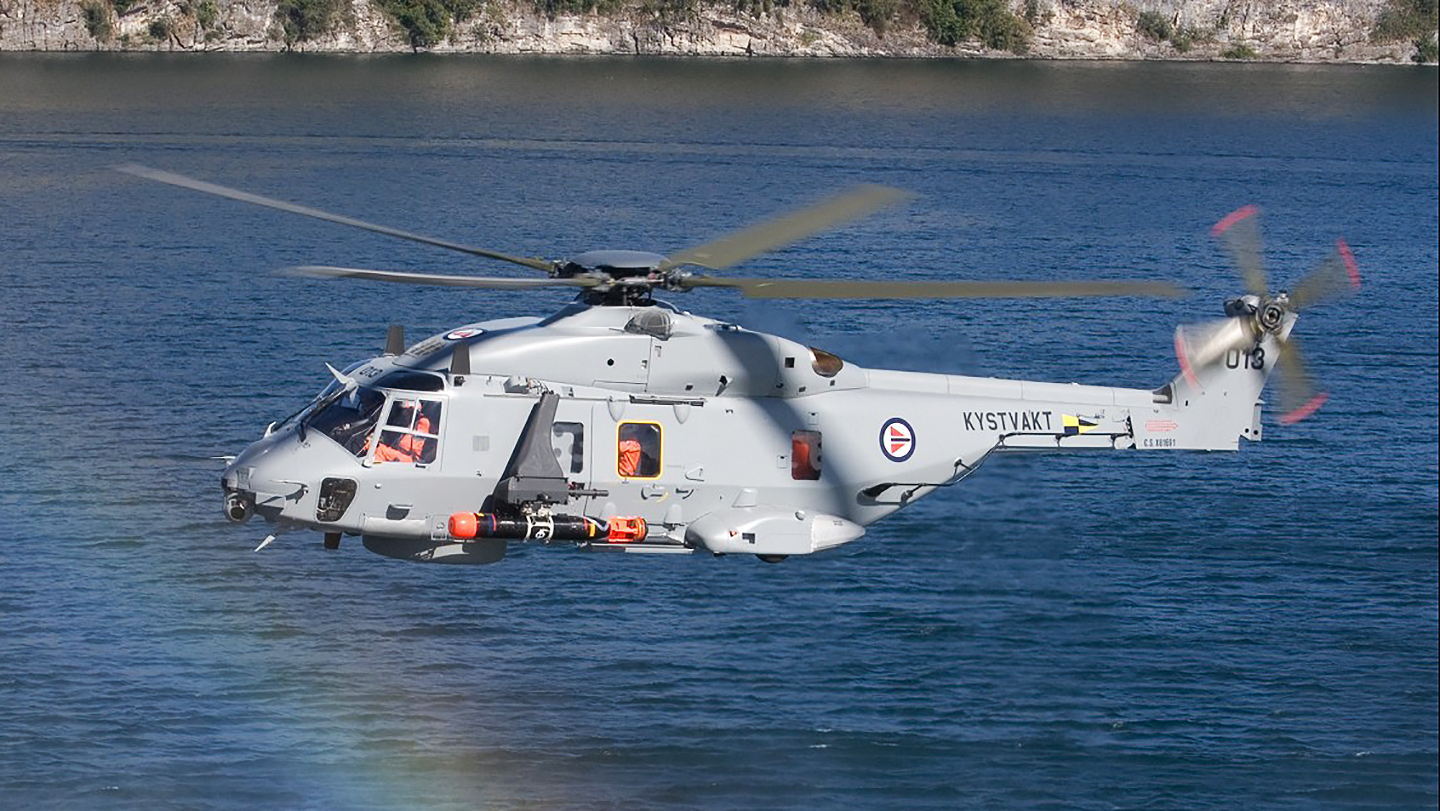
The NH90 comes in two main variants, each optimized for specific mission sets:
🚁 NH90 TTH (Tactical Transport Helicopter)
- Designed for land-based operations, including troop transport, logistics, special operations, and casualty evacuation.
- Can carry:
- Up to 20 troops
- Or 12 stretchers
- Or 4,200 kg of cargo (internal or underslung)
🚁 NH90 NFH (NATO Frigate Helicopter)
- Configured for maritime missions such as Anti-Submarine Warfare (ASW), Anti-Surface Warfare (ASuW), and search and rescue (SAR).
- Equipped with:
- Dipping sonar
- Sonobuoys
- Anti-ship missiles
- Radar and Electronic Support Measures (ESM)
- Automatic blade and tail folding for shipboard storage
6. Survivability and Protection
🛡️ Low Observability
- The use of composite materials, smooth fuselage lines, and IR suppressors reduces radar and thermal signatures.
🛡️ Ballistic and Crash Protection
- The NH90 features armored crew seats, self-sealing fuel tanks, and crashworthy landing gear and structure.
🛡️ Defensive Aids Suite
- Includes radar warning receivers, laser warning systems, missile approach warning systems, and chaff/flare dispensers.
7. Operational Performance
🌐 Global Service
- As of 2025, more than 500 NH90s have been delivered to 14 countries, including Germany, France, Italy, Australia, New Zealand, and Finland.
⏱️ Flight Hours & Reliability
- Accumulated over 400,000 flight hours, with increasing reliability thanks to ongoing upgrades.
🔧 Upgrade Path
- Recent upgrades (e.g., Software Release 3) improve mission capability, software integration, and interoperability.
- The NH90’s modular architecture ensures long-term sustainability, with an expected service life of up to 50 years.
8. Challenges and Criticism

Despite its strengths, the NH90 program has faced criticism in the past:
- Initial delays and cost overruns impacted customer confidence.
- Early variants had maintenance complexity and limited availability, prompting feedback from some users.
- However, most of these issues have been progressively resolved through updates, better support infrastructure, and user-driven modifications.
9. Conclusion
The NH90 is a technological leap forward in military helicopter design, offering unmatched versatility, survivability, and network integration. It represents a true multi-role platform capable of adapting to both land and sea environments, from transporting special forces to hunting submarines in hostile waters.
As NATO countries and partner nations continue to modernize their fleets, the NH90 stands as a cornerstone in 21st-century rotary-wing capability, combining innovation with battlefield resilience.