When it comes to cutting-edge fighter jets, the F-22 Raptor stands in a league of its own — and its high-speed performance is a key reason why. Designed by Lockheed Martin, this fifth-generation stealth fighter redefines what it means to dominate the skies, blending speed, agility, and technology like no other aircraft.
Breaking the Speed Barrier: A Historical Milestone
The F-22 program began in the 1980s during the Cold War, as the U.S. sought to maintain air superiority against emerging advanced Soviet fighters like the MiG-29 and Su-27. Officially entering service in 2005, the Raptor embodied decades of aerospace innovation, fusing stealth, avionics, and raw speed. Its ability to cruise supersonically without afterburners — a feat known as supercruise — was revolutionary, outpacing previous fighters such as the F-15 Eagle and F-16 Fighting Falcon.
Blazing Through the Skies: The Technical Breakdown
The F-22 boasts a top speed of Mach 2.25 — that’s more than twice the speed of sound, roughly 1,500 mph (2,414 km/h). This astonishing velocity allows the Raptor to engage or disengage on its own terms, striking quickly and disappearing before enemies can react.
At the heart of this performance are its two Pratt & Whitney F119-PW-100 engines, each delivering over 35,000 pounds of thrust. Unlike traditional engines that rely heavily on afterburners for supersonic speeds (which drastically increase fuel consumption and heat signature), the F-22’s engines enable sustained supersonic cruise without afterburners, dramatically extending mission range and stealth.
Further amplifying its dominance is the thrust vectoring nozzles, which can direct engine thrust up or down by 20 degrees. This technology grants the Raptor unparalleled maneuverability at both high and low speeds, allowing it to out-turn and out-climb adversaries even in the tightest dogfights.
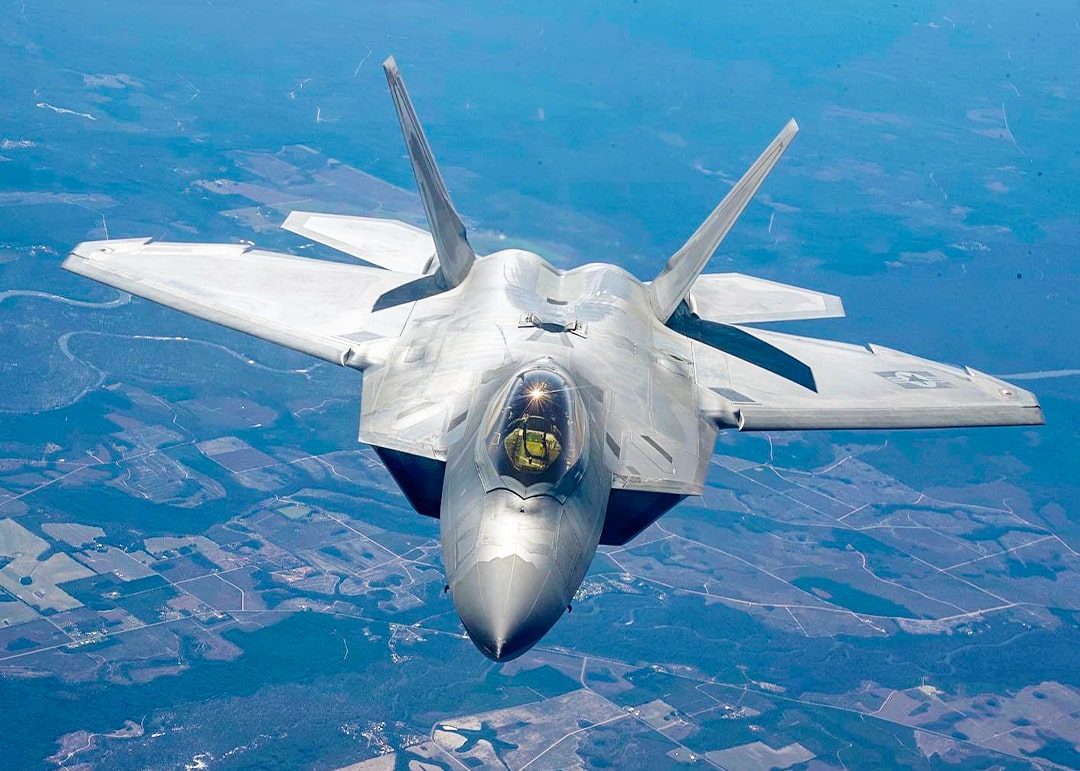
Its aerodynamic design is equally critical. The F-22’s sleek fuselage, blended wing-body shape, and canted tail fins minimize drag and radar cross-section. The extensive use of radar-absorbent materials ensures that even at high speeds, the jet remains virtually invisible to enemy radar systems.
Why Speed is a Game-Changer in Modern Warfare

In today’s combat environment, speed is not just about chasing or fleeing—it’s about tactical advantage. The F-22’s high-speed capabilities mean it can quickly intercept enemy aircraft, launch weapons before the enemy is aware, and retreat to safety before a counterattack. Its supercruise means it can maintain these speeds for extended periods, which was impossible for earlier jets without resorting to fuel-guzzling afterburners.
Combined with advanced avionics, sensor fusion, and stealth, the Raptor’s speed lets it control the aerial battlefield, forcing adversaries to react to its moves rather than dictate the terms of engagement.
Conclusion
The F-22 Raptor’s high-speed capability is not just about breaking records; it’s about reshaping the rules of air combat. From its Cold War origins to its status as the apex predator in the sky today, the Raptor combines speed, stealth, and agility in a way that few fighters can match. Every Mach 2+ dash it makes is a reminder of the engineering marvel and tactical brilliance that defines modern air dominance.