Executive summary
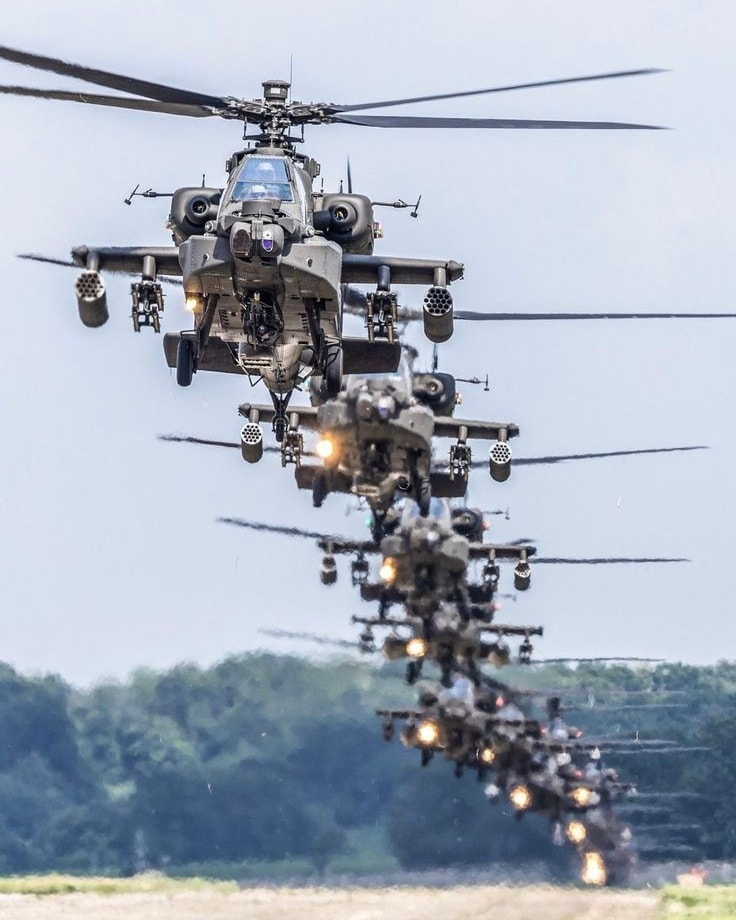
The AH-64 Apache family remains one of the world’s most capable dedicated attack helicopters. It combines robust airframe and survivability features with advanced sensors, integrated fire control and a versatile weapons suite optimized for anti-armor, close air support (CAS), escort and armed reconnaissance. Its effectiveness depends heavily on ISR integration, electronic-warfare support and sustainment infrastructure; in high-threat environments survivability is a function of combined-arms tactics rather than platform capability alone.
Platform overview
The Apache is a two-crew, tandem-cockpit, twin-engine attack helicopter designed to detect, engage and destroy armored and soft targets in day/night and degraded-visual conditions. Typical missions include dedicated anti-armor strike, armed escort for transport helicopters, precision CAS for ground forces, armed reconnaissance and protected overwatch of maneuver formations.
Development and principal variants

-
AH-64A — original production type: baseline weapons/sensor fit and avionics for the 1980s/1990s battlefield.
-
AH-64D (Longbow) — added mast-mounted fire control radar (Longbow), improved avionics and weapons integration for faster target acquisition and simultaneous engagement of multiple targets.
-
AH-64E (Guardian, previously Block III) — modernized engines, drivetrain improvements, upgraded mission computers, improved datalinks and networking, ability to control and integrate unmanned aerial systems (UAS), improved rotor system and enhanced situational awareness.
(Export and service configurations vary by operator; many nations operate customized blocks with national avionics and self-protection suites.)
Airframe, propulsion and survivability features
-
Airframe: crashworthy structure with armored crew compartments and redundant flight controls typical of frontline attack helicopters.
-
Engines: twin turboshafts sized to provide high power margin for weapons/armor loads and hot/high performance; improved powerplants on later blocks increase payload and hover capability.
-
Survivability: features include infrared suppression measures, engine and fuel system protections, redundant systems, automated self-test and self-diagnostics, and countermeasure dispensers (flares/chaff) plus radar/laser warning receivers depending on fit. The Apache’s design balances armor and agility; survivability in contested environments is enhanced by tactics, EW support and SEAD efforts.
Sensors, avionics and targeting
-
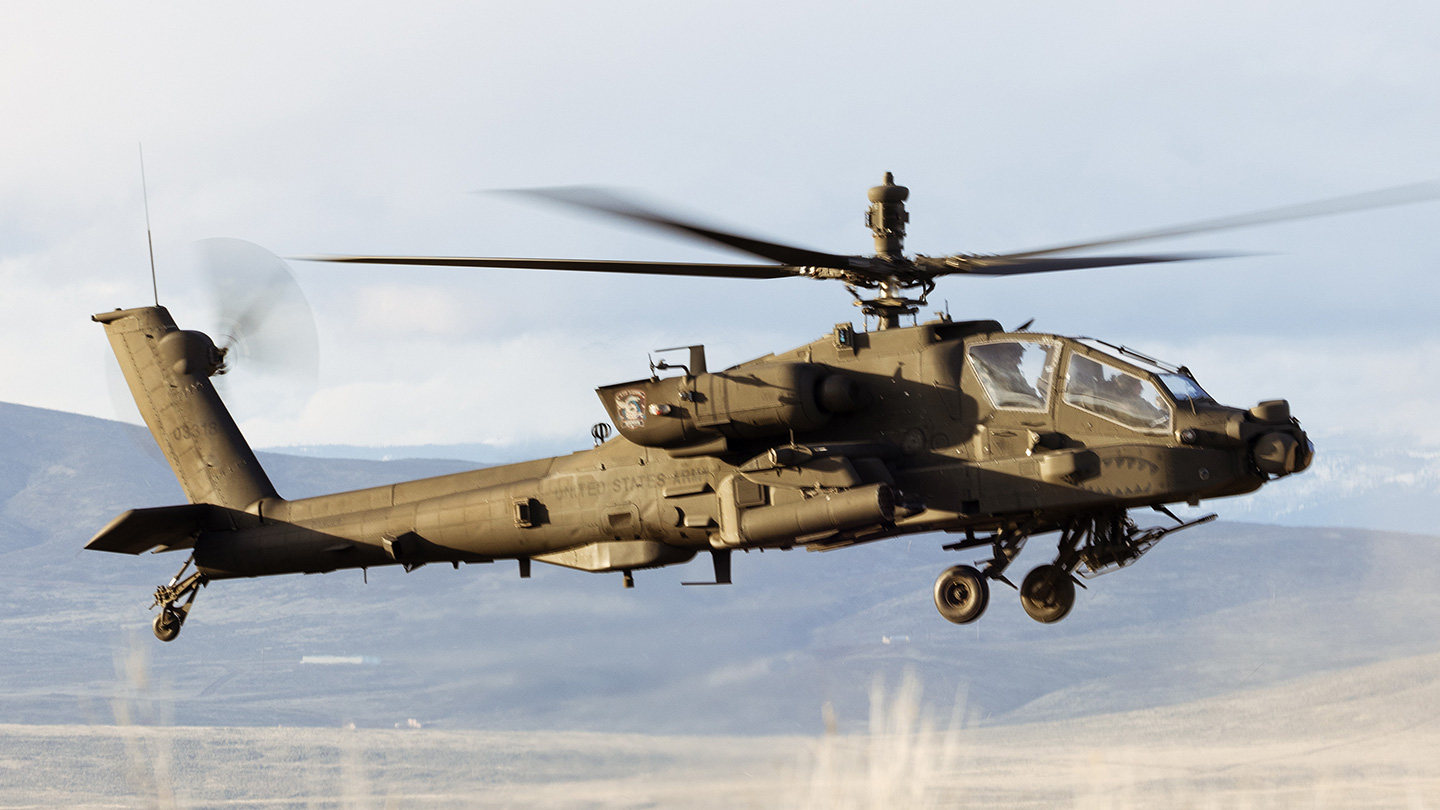
TADS/PNVS (targeting and pilot-night vision systems): stabilized electro-optical FLIR, laser designator/rangefinder and direct-view displays enable day/night precision targeting.
-
Helmet-mounted displays: allow the gunner/pilot to cue sensors and weapon aim with head movement.
-
Fire control radar: Longbow mast-mounted radar (on D/E variants when fitted) provides rapid detection and classification of armored targets and supports engagement of multiple targets with guided missiles.
-
Networking: modern Apaches include secure datalinks, digital data buses, and interfaces for off-board ISR (including UAS handoff) — enabling sensor fusion, cooperative engagement and improved situational awareness for distributed forces.
Weapons and loadouts
-
30 mm chain gun (chin-mounted): effective for point targets, light armor and suppression.
-
Guided anti-armor missiles: AGM-114 Hellfire family (or equivalent) is the primary standoff antitank weapon for precision, top-attack or direct-attack profiles.
-
Unguided rockets: 2.75-inch rocket pods for area suppression, marking and anti-personnel use.
-
Optional air-to-air/self-defense: short-range missiles or machine-gun pods may be carried for limited air defense or self-protection depending on doctrine.
Loadouts are mission-specific and balanced between standoff anti-armor capability and close-in CAS/escort requirements.
Typical tactics and employment concepts
-
Standoff, sensor-driven engagements: use of targeting sensors and guided missiles to engage armored threats from outside effective enemy point-defense ranges when possible.
-
Combined-arms integration: success depends on ISR (UAS, reconnaissance, ground observers), SEAD/EW to reduce air-defense threats, and coordination with ground maneuver units for target priorities and deconfliction.
-
Nap-of-the-Earth (NOE) and terrain masking: low-level flight can reduce radar exposure but increases detection by visual and IR systems and raises pilot workload.
-
Night and degraded-visual ops: the Apache excels here due to FLIR and night-capable avionics, enabling surprise and greater survivability if supported by navigation aids and datalinks.
-
UAS teaming: modern doctrine emphasizes sensor-to-shooter chains where smaller UAS find and lase targets, enabling the Apache to remain outside certain threat envelopes while employing precision weapons.
Strengths

-
Precision anti-armor capability — long-range guided missiles with top-attack profiles are highly effective versus modern armor.
-
Sensor fusion and night capability — allows persistent hunting and target engagement in limited-visibility conditions.
-
Versatility — adaptable to CAS, escort, armed reconnaissance and maritime approaches with appropriate loadouts.
-
Psychological and tactical shock — concentrated Apache presence shapes battlefield tempo and can deter or dislocate enemy maneuver.
Vulnerabilities and operational risks
-
Short-range air-defense threats: MANPADS, vehicle-mounted SAMs and heavy autocannons pose a significant hazard in low-altitude transit and hover.
-
Swarm and loitering munitions: proliferating threats (drones/loitering munitions) can target helicopters on the ground and in flight, stressing airbase/FARP defenses.
-
Electronic warfare: jamming and GPS disruption degrade navigation, datalink and targeting, especially where reliance on off-board sensors is high.
-
Logistical dependence: high sortie rates require secure FARPs, fuel and ordnance throughput plus trained maintainers — operational tempo is constrained by sustainment.
Mitigation relies on combined-arms (SEAD, EW, UAS screens), dispersion, robust base defense and active/passive self-protection.
Sustainment, basing and force generation
-
Logistics footprint: fuel, munitions (particularly Hellfires), spares and gearbox/engine maintenance are resource-intensive.
-
FARP concept: forward arming and refueling points extend reach but require security and hardened protection.
-
Crew training: high crew workload demands extensive simulator and live-flight training for formation flight, nap-of-earth, target acquisition and combined-arms procedures.
Operational history (broad observations)
Apaches have performed across a wide spectrum of conflict — from high-intensity anti-armor operations to COIN and urban CAS missions — demonstrating adaptability and lethality when integrated into a joint force. Their demonstrated effectiveness increases with quality of ISR support and the degree of suppression of hostile air defenses.
Modernization and future trajectories
-
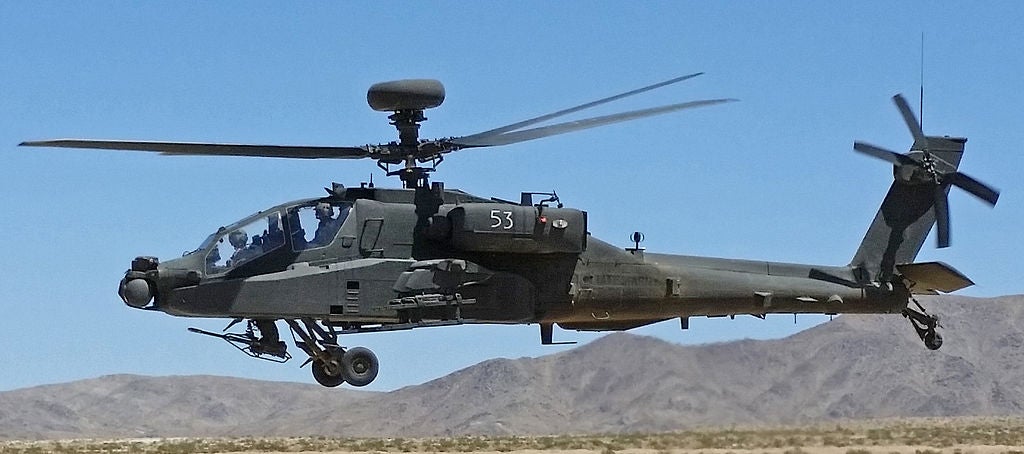
Networked operations & manned-unmanned teaming will continue to be force multipliers; Apaches can act as shooters in distributed sensor networks.
-
Improved survivability suites (advanced EW, sensors, active protection and soft-kill systems) will be prioritized as low-cost, small-UAS and advanced MANPADS proliferate.
-
Propulsion and drivetrain upgrades aim to increase payload and hot/high performance to support heavier sensors and future weapons.
-
Potential integration with longer-range precision munitions and better multi-spectral sensors will extend standoff engagement options.
Conclusion
The Apache remains a premier attack helicopter because it fuses precision lethality with advanced sensors and networking. Its battlefield value is maximized when employed as part of integrated, combined-arms operations that mitigate its vulnerabilities to air defenses and emerging asymmetric threats. Future survivability and relevance will hinge on improved EW, UAS integration and sustainment solutions that keep the type effective in increasingly contested, networked battlefields.