1. Origins and Development Philosophy
-
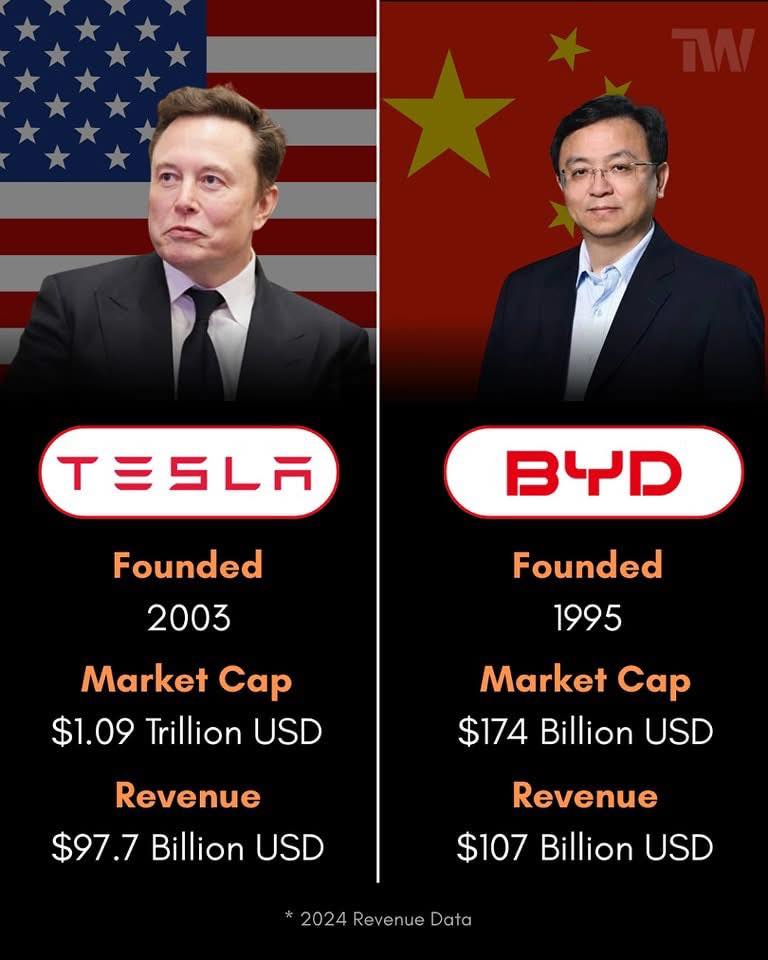
Tesla (USA, 2003): Transformed by Elon Musk into a symbol of technological innovation, Tesla focuses on shaping EVs as premium products—integrating artificial intelligence, a software ecosystem, and a global charging infrastructure. Tesla’s philosophy goes beyond car manufacturing; it aims to redefine how humanity consumes energy through batteries, solar power, and energy storage.
-
BYD (China, 1995): Starting as a battery manufacturer, BYD quickly expanded into automobiles and grew into China’s EV giant. Unlike Tesla, BYD emphasizes mass affordability, product variety, and practicality—from passenger cars to electric buses. This strategy fits China’s massive domestic market and the global push for affordable EV adoption.
2. Scale and Financial Strength
-
Tesla boasts a dominant market capitalization ($1.09 trillion), reflecting investor confidence in its technological growth and business model. However, its revenue ($97.7 billion in 2024) trails BYD’s, showing Tesla sells fewer cars but enjoys higher profit margins and stronger brand valuation.

-
BYD achieved higher revenue than Tesla ($107 billion in 2024), yet its market capitalization is only about one-sixth of Tesla’s. This highlights BYD’s focus on volume and market share growth rather than maximizing margins.
3. Technology and Product Strategy
-
Tesla leads with Autopilot/Full Self-Driving, OTA software updates, and a battery & Supercharger ecosystem. The brand is synonymous with breakthrough innovation and dominates the premium EV segment.
-
BYD stands out with its Blade LFP battery—safe, durable, and cost-effective. This allows BYD to lower production costs and expand into the mass-market EV segment. Beyond China, BYD is aggressively exporting to Europe, Southeast Asia, and Latin America.

4. Market Presence & Global Strategy
-
Tesla focuses on North America, Europe, and China (with its Gigafactory in Shanghai). Tesla’s presence is a global symbol of innovation.
-
BYD dominates in China’s domestic market, where government subsidies fuel EV adoption. At the same time, BYD is accelerating global expansion, increasingly challenging Tesla in Europe and South America.
5. Strategic Impact
-
Tesla represents “technology-driven value creation”—fewer models but disruptive enough to reshape the auto industry.
-
BYD embodies “scale and cost-driven production”—democratizing EVs and leveraging its domestic market power to expand worldwide.
🔎 Conclusion
-
Tesla: A tech icon, leading in valuation and brand power, shaping the future of premium EVs and artificial intelligence.
-
BYD: A mass-production powerhouse, China’s strategic weapon in the electrification race, now rivaling Tesla in revenue.
👉 This rivalry reflects two philosophies: the U.S. creates the “technological dream,” while China turns it into “a reality for the masses.”