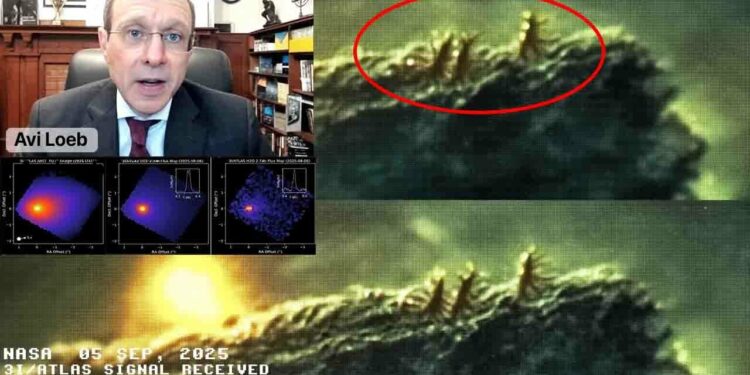
Hold onto your telescopes—what was supposed to be a sleepy interstellar snowball has turned into the kind of cosmic thriller that keeps late-night talk shows buzzing. Harvard’s own Avi Loeb is claiming the newest high-res photos of 3I/ATLAS reveal something that should not, by any stretch of current science, exist: a tiny object putting out the power of ten nuclear reactors. And if he’s even partly right… we are not just looking at a strange rock. We might be looking at a deliberate visitor.
The drop-the-mic opener: ATLAS spotted an interstellar object. The world relaxed — “just another comet,” people said. But Hubble and Webb pictures don’t behave like pictures of ordinary comets. Instead of a tail waving away from the Sun, 3I/ATLAS sports a teardrop-shaped glowing cocoon aimed toward the Sun. The light falls off too fast; its brightness curve is stranger than a Hollywood plot twist. Loeb crunched the numbers and—boom—concluded the illumination probably comes from inside the object. Ten gigawatts. Not a trickle, not a flare—10 GW, a continuous beacon slicing through the cold.
Size mystery: If sunlight were doing the lighting, 3I/ATLAS would have to be enormous—on the scale of miles—enough to silence any cozy assumptions. But if the light is self-generated, the craft could be surprisingly small: a few hundred feet, humming with the energy of a small nation. A tiny package with colossal power. Nature, meet your match.

Trajectory with purpose? Random interstellar junk should come at us from any angle. This thing? It’s riding practically in the ecliptic — the same cosmic highway planets use. Odds it lined up so nicely by chance? Tiny. And its path reads like a sightseeing itinerary: a close-ish brush with Mars on October 3, 2025 (HiRISE, get ready), then onward toward Jupiter. Coincidence or reconnaissance? Loeb says the motion looks “fine-tuned.” Cue the goosebumps.
Chemical curveball: Webb finds a gas cloud loaded with CO₂ and almost no water—odd for a comet. Could it be exotic origin chemistry? Sure. But Loeb dares to ask: what if the CO₂ is dust or waste from something working—a machine, a factory, or worse, a biological process?
Theories that make you sleep with the light on
-
The Cautious Camp: Most astronomers beg for restraint. Weird doesn’t equal alien—they remind us that the universe invents stranger things every day. Patience, more data, natural explanations: their refrain.
-
The Loeb Coalition: A smaller, louder group says enough anomalies stack up to demand radical thinking. Engine-like glow + improbable path + odd chemistry = the possibility of artificial origin. Loeb gives 3I/ATLAS a 4/10 on his own “Loeb Scale” — not a smoking gun, but not something to ignore either.
Panspermia or Pandora? Buckle up. One spine-tingling hypothesis: 3I/ATLAS could be a panspermia probe—a deliberate seed ship designed by an alien civilization to spread life. Think of it as cosmic agriculture: arrive, release microscopic building blocks, and let new biospheres sprout. Terrifying twist—if those organisms don’t play nice with Earth life, they could rewrite ecosystems, not maliciously, just efficiently. Welcome to the ultimate invasive species.
But darker still: what if it’s a test? Enter the Great Filter nightmare. Some thinkers propose autonomous “Berserker” devices that seek and sterilize budding civilizations. Did our attention flare it up? Did our radio chatter or telescope beams awaken a dormant sentinel that then powered up to 10 GW? The fragments breaking off—natural break-up or deployed strike-packages? Loeb raises the possibility, and suddenly sci-fi horror is knocking at the lab door.
What’s next? The moment of truth
October 3, 2025. Mars, HiRISE, and the world’s screens. If HiRISE can peel apart the glow and show us a manufactured shape, all bets are off. If the images show jagged rock and explainable physics, breathe. But if we see structure… humanity’s bedtime stories just changed genre.
Editor’s spicy commentary
-
“Scientists: don’t panic. Loeb: prepare your theories.”
-
“If it’s a seed ship — congratulations? Or condolences?”
-
“Triggered by our own curiosity? Ironic and terrifying.”
Social media sound bites
-
“10 GW in a pebble? Nature’s been hiding something.”
-
“If it’s a probe, who forgot to tell us aliens don’t do postcards?”
-
“Mars is about to be the paparazzi of the solar system.”
Bottom line (no safety pins): We’re at a crossroads between respectable restraint and full-blown cosmic scandal. Either astronomers will solve an unprecedented natural puzzle, or we will be nudged—gently or violently—into confronting the possibility that someone, somewhere, built machines that can cross the void and, perhaps, choose what to do when they arrive. Keep your telescopes ready and your skepticism sharper. This story is far from finished — and if Loeb is right, the universe just RSVP’d to our little blue party.
— Your tabloid orbit correspondent, watching the skies and whispering to the stars.