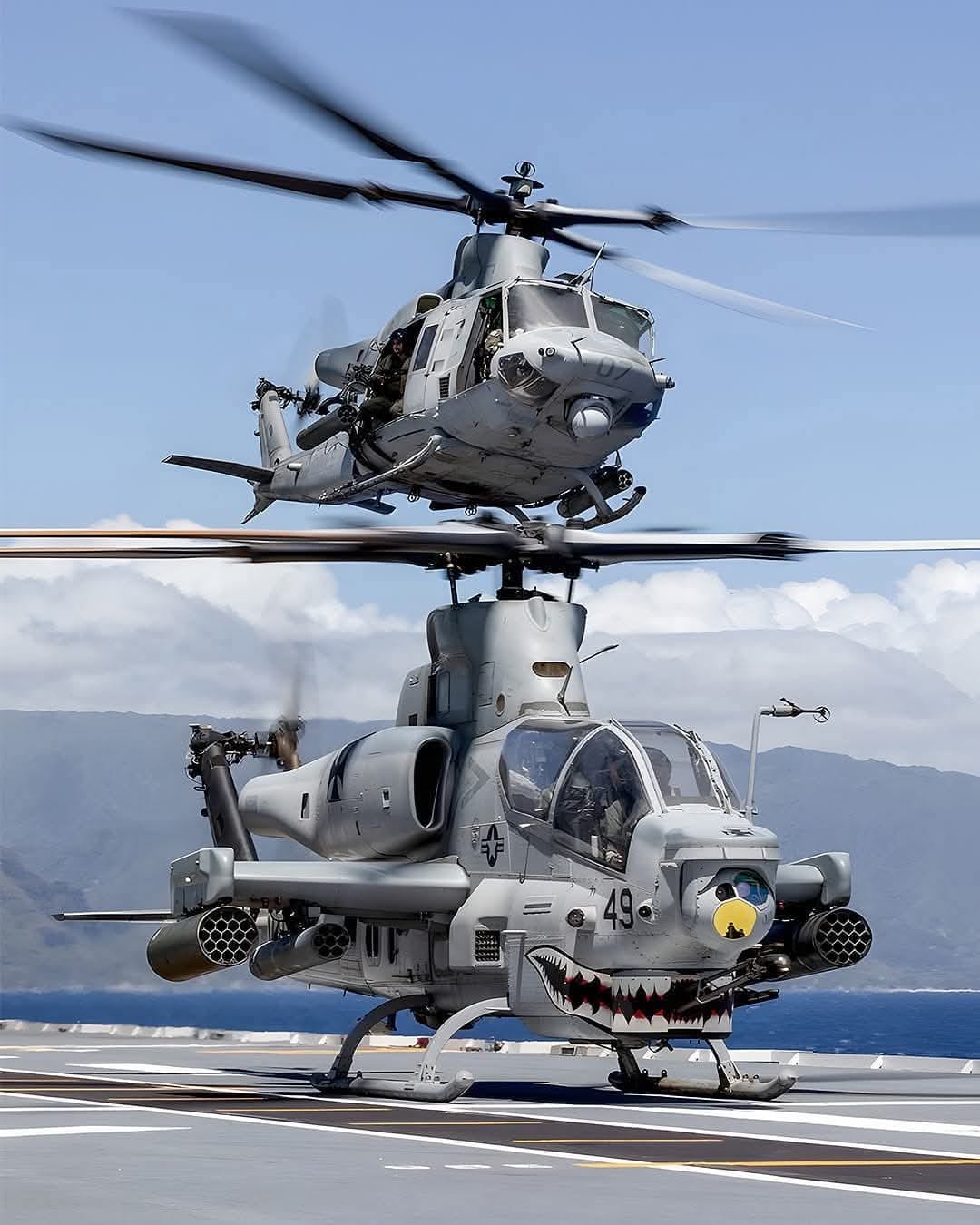
This striking image captures two of the United States Marine Corps’ most formidable rotary-wing aircraft: the AH-1Z Viper attack helicopter and the UH-1Y Venom utility helicopter. Operating in tandem, these helicopters exemplify modern battlefield versatility, combining firepower, agility, and support capabilities in a compact, highly maneuverable package.
The AH-1Z Viper, pictured in the foreground, is a dedicated attack helicopter designed for close air support, anti-armor operations, and armed reconnaissance. Its sleek fuselage is equipped with a 20mm chin-mounted cannon, rocket pods, and guided missile systems. The distinctive shark-mouth paint on the nose adds a psychological edge, harkening back to the legacy of historic combat helicopters.
Above, the UH-1Y Venom demonstrates its utility and troop transport capabilities. As a modernized version of the iconic “Huey,” it retains a flexible design capable of carrying troops, cargo, or medical evacuation loads, while also supporting armed missions with rockets and machine guns. Its four-blade rotor system and twin engines provide enhanced lift, speed, and survivability in challenging operational environments.
Together, these aircraft reflect the USMC’s commitment to integrated air-ground operations, where attack and utility helicopters operate in close coordination to maximize tactical impact. The combination of offensive firepower, rapid troop deployment, and adaptability to diverse missions makes them indispensable in modern warfare scenarios—from amphibious assaults to counter-insurgency operations.