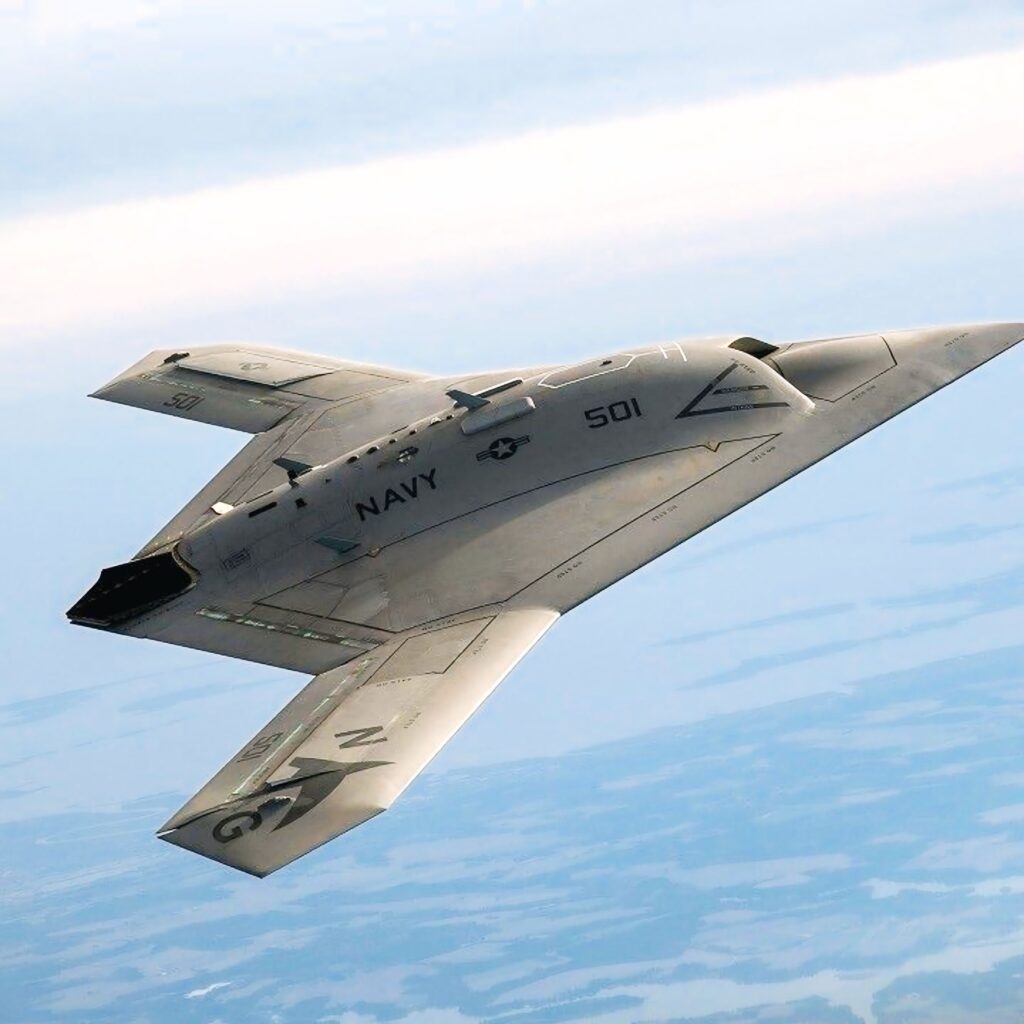
The Northrop Grumman X-47B stands as a landmark in unmanned military aviation. As one of the first carrier-based drones capable of fully autonomous operations, it proved that aircraft without a pilot onboard could safely launch from, navigate around, and land on a moving aircraft carrier—a feat once deemed impossible.
Developed under the U.S. Navy’s Unmanned Combat Air System Demonstration (UCAS-D) program, the X-47B made its first flight in 2011. Its sleek, tailless “flying wing” design not only evokes the B-2 Spirit stealth bomber but also enhances survivability by reducing radar signature. With a 62-foot wingspan, subsonic speeds, and a combat radius of roughly 2,100 nautical miles, the drone could carry up to 4,500 pounds of ordnance internally—preserving stealth while testing advanced operational capabilities.
The program achieved historic milestones: in May 2013, the X-47B successfully catapult-launched from the USS George H.W. Bush and made arrested landings, demonstrating seamless integration with carrier operations. By 2015, it had completed autonomous aerial refueling, proving that unmanned aircraft could extend range and endurance for future missions.
Beyond technology, the X-47B pioneered “manned-unmanned teaming,” operating safely alongside crewed aircraft to explore new tactics for combat effectiveness. Though the UCAS-D program ended in 2015, its legacy lives on—informing programs like the MQ-25 Stingray and shaping the next generation of autonomous naval aircraft for strike, surveillance, and electronic warfare.
The X-47B didn’t just test drones—it charted the course for 21st-century naval aviation, where autonomous systems will take flight alongside humans in complex, high-stakes operations.