The news didn’t break like a headline.
It didn’t arrive with clarity, nor with the structure of an explanation.
Instead, it surfaced in fragments—pieces of heartbreak scattered across YSL Woody’s social media, each caption carrying the weight of a grieving father trying to stay afloat.
He hadn’t planned to share his pain with the world.
But grief has a way of spilling over, even when someone tries to hold it tight.
And for Woody, the loss of his newborn son—a baby just over one month old—was too heavy to keep inside.
Too devastating to process alone.
Too silent to bear without cracking open.

So he began to post.
Sentence by sentence.
Emotion by emotion.
Until the world realized what had happened.
His followers, the “roommates,” as he affectionately called them, saw the shift immediately.
There was no mistaking it—the tone of his words, the tremble behind every phrase, the kind of raw, unfiltered ache that makes the whole world pause.
“Life ain’t worth living anymore,” he wrote.
Just six words, but they carried the gravity of a man at rock bottom.
A man who had just buried the future he had dreamed of.
Then came another message:
“I know this isn’t the work of the Lord, Satan will never win.”

Fans read these sentences like alarm bells.
They reposted them, shared them, whispered prayers over them.
They knew this wasn’t just sadness—this was a father bleeding through his own words.
What happened?
When did the baby pass?
How did this happen?
Questions flooded timelines, but answers did not.
Only the grief remained.
Woody continued posting—memories, videos, photos.
Moments of him holding the tiny boy.
Moments of the child’s mother smiling softly in the background.
Moments of possibility that now existed only in pixels.

He didn’t say the baby’s name.
Maybe it hurt too much.
Maybe names make losses real.
Maybe names echo in a way grief simply can’t handle.
What he did reveal was the truth of his heartbreak.
“You made me feel something, now I’m numb,” he wrote.
“I been doing right by ppl.”
“Someone gonna pay.”
The words weren’t threats.
They weren’t anger in the dangerous sense.
They were a father’s scream into the void—a desperate attempt to blame something, anything, for a world suddenly split open.

Fans rushed in instantly.
“It is worth living ❤️,” one person wrote.
“My condolences,” another left, heartbroken emojis trailing behind their words.
“You’ve got people who love you, bro, stay strong,” someone else wrote with prayer hands and broken hearts.
The comment section became a vigil.
A place of mourning.
A place of unity for strangers who understood the universal language of loss.
But what many didn’t know—what Woody didn’t say out loud—was how deeply he had loved this baby before the boy ever took his first breath.

Just weeks earlier, he had been on livestream with his longtime girlfriend.
A casual evening.
A normal conversation.
A moment now frozen in bittersweet memory.
She rubbed her baby bump as questions poured in.
Someone asked: “What’s the gender?”
Woody couldn’t contain himself.
His face lit up—bright, genuine, proud.
“It’s a boy!” he announced, his smile stretching wide enough to touch the edges of the screen.

Fans cheered for him.
This would be his first son.
He already had daughters—little girls he loved fiercely—but a son felt like a new chapter.
A new beginning.
A future he couldn’t wait to step into.
That happiness had come just days after he survived a frightening bike accident.
Fans had worried he wouldn’t recover.
They had sent prayers, messages, wishes for healing.

He survived.
He healed.
He believed the universe was giving him a second chance.
A chance to be a better man.
A chance to raise a son.
A chance to rewrite his story.
And then, without warning, the future vanished.
The second chance shattered.
The grief that followed didn’t whisper—it roared.
It filled his home like smoke, thick and suffocating.
It followed him into silence.
It crawled into every corner of his day.

He tried to cope by revisiting memories.
Scrolling through videos—tiny hands, soft breaths, the way the baby curled against his chest.
He replayed them over and over.
Sometimes he smiled.
Sometimes he broke.
The baby’s mother grieved quietly beside him.
Her eyes stayed red for days.
Her voice grew small, as though each word required too much strength.
When she held the baby’s blanket, she pressed her face into it, hoping to keep the newborn’s scent alive just a little longer.
They were supposed to be learning swaddles, not planning goodbyes.
They were supposed to be arguing over diapers, not funeral arrangements.
They were supposed to be exhausted from late-night feedings—not from crying.

The world saw only pieces of the story—but those who knew Woody understood the depth beneath the fragments.
They knew he had been a man fighting demons long before fatherhood.
They knew he had grown up faster than most kids should.
They knew music had been his escape, his expression, his lifeline.
But this loss—it cut deeper than anything.
This was the first time he had ever felt joy and devastation collide so violently.
He tried to pray.
Some days the prayers felt like whispers.
Other days they felt like shouts hurled at a sky that wouldn’t answer.

He wrote: “Satan will never win.”
Not because he believed he was losing the battle—
but because he needed to believe his son’s short life had meaning.
That it wasn’t taken without purpose.
That grief would not swallow him whole.
As the days passed, fans continued showing up.
The comment section became a community—people sharing their own stories of loss, speaking encouragement into Woody’s darkness.
Some had lost babies.
Some had lost siblings.
Some had lost parents.
They understood the shape of heartbreak.

And their words began to form a kind of net beneath him.
Soft enough to hold him.
Strong enough to keep him from falling too far.
But grief is not linear.
Some mornings he woke up feeling numb.
Other mornings he felt everything at once.
Some days he stared at the ceiling for hours.
Other days he opened his phone and scrolled through condolences until his eyes burned.
The pain came in waves.
Heavy, unrelenting, unpredictable.
But slowly—very slowly—he began to talk about the moments he cherished.

The first night he held his baby boy.
The way the tiny fingers wrapped around his.
The soft cry that filled the room.
The feeling of becoming a father to a son—a feeling he would never forget.
He remembered the dreams he had:
teaching him to walk.
to ride a bike.
to make music.
to be better than him.
He remembered whispering promises into the newborn’s ear:
“I got you.”
“I’m here.”
“You’re safe.”

And even though the baby was gone, the promises remained—floating in the air between what was and what could’ve been.
One night, after days of silence, Woody posted a video.
A soft lullaby played in the background.
His son slept peacefully on his chest, wearing a tiny blue onesie.
Woody’s hand rested over the baby’s back, rising and falling with each little breath.
The caption was only three words:
“My whole heart.”
Fans knew instantly—it was a goodbye.
A memorial.
A father holding the only thing left of the future he had imagined.

As more messages poured in, Woody didn’t respond.
He didn’t have to.
The world understood.
Grief doesn’t need explanation.
It only needs space.
In the weeks that followed, Woody’s friends kept him close.
They called.
They checked on him.
Some sat with him in silence.
Others held him when the grief became too much.

His mother visited often.
She cooked for him, prayed for him, told him stories of when he was a baby—trying to remind him that life, even broken, could still hold moments of healing.
But healing doesn’t come quickly after a loss like this.
It comes in slow breaths.
In tiny steps.
In remembering without unraveling.
And Woody—somehow—kept going.

Not because he stopped hurting.
Not because the pain lessened.
But because his baby boy deserved a father who survived this.
A father who lived.
His supporters continued to lift him up, reminding him:
“It IS worth living.”
“There’s still purpose left.”
“Your baby would want you here.”
And little by little, those words began to take root.
He still posted memories.
He still cried.
He still broke down.
But he also began to breathe again.
Not fully.
Not easily.
But enough.

Enough to say his son’s life mattered.
Enough to let grief coexist with love.
Enough to believe that one day, he might feel light again.
And when he finally posted a final tribute—a photo of his baby’s tiny footprint—he wrote:
“I’ll carry you forever.”
It wasn’t closure.
It wasn’t healing.
But it was the beginning of it.
A father learning to live with a love that didn’t get enough time.
A father holding onto the memory of a son who changed him forever.
A father choosing to stay.
The Judge Who Sentenced a Monster… Then Went to Meet the Victim Who Couldn’t Speak.4981
There are cases that shake a courtroom.
There are cases that haunt a judge.
And then there are cases that change a man so deeply that the robe, the gavel, and the rigid distance between law and emotion all fall away.
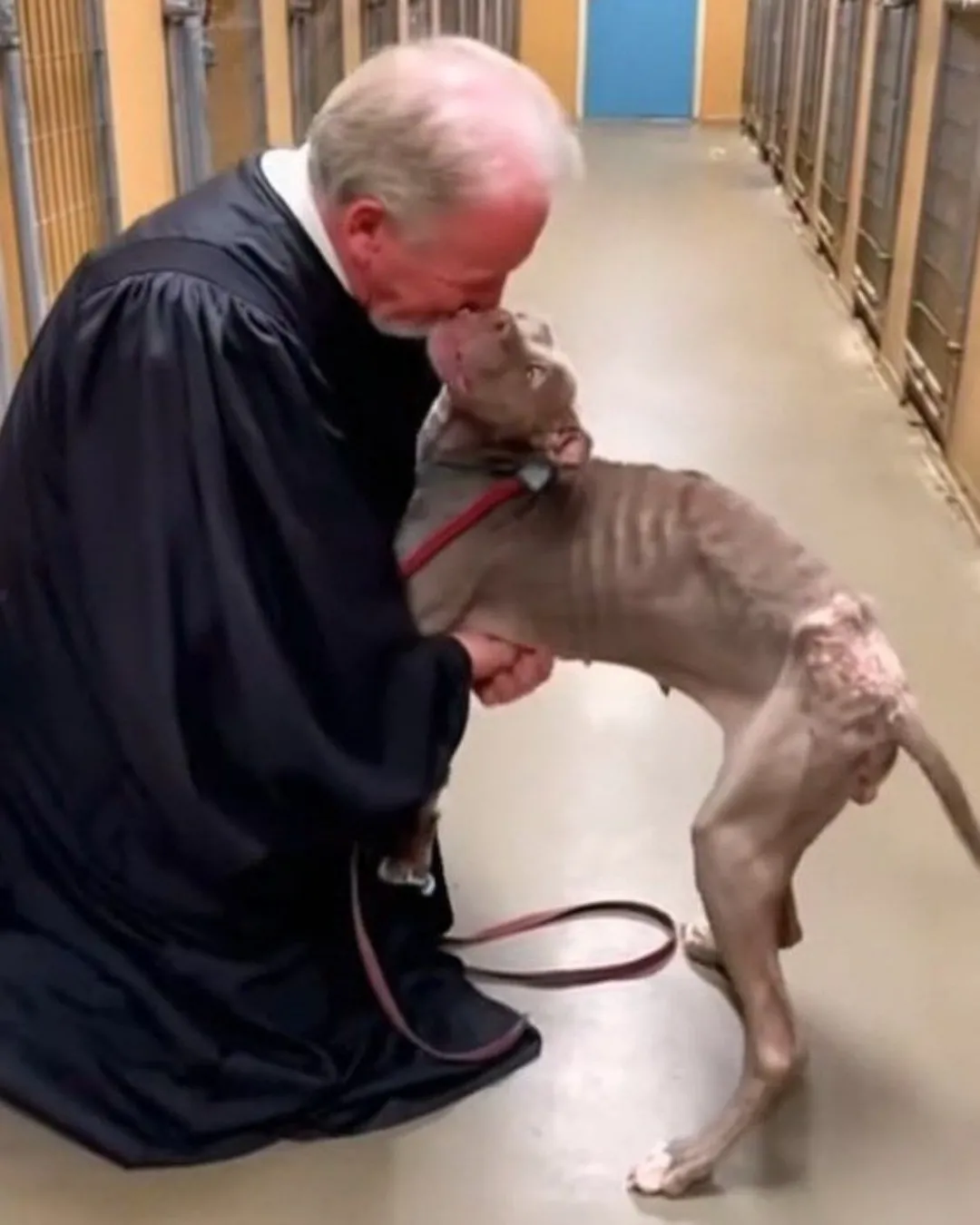
This is the story Judge Martin Wallace never expected to become part of.
A story about a crime that left even a 30-year veteran of the bench unable to sleep.
A story about a victim who, unlike every other victim he had ever encountered, could not speak, could not testify, and could not point to the face of the person who hurt him.
A victim who weighed barely more than his own bones.
A dog named Finn.
THE CASE THAT BROKE A JUDGE
Judge Wallace had handled murder trials, domestic violence cases, high-profile assaults—cases that made headlines and shook communities. After three decades on the bench, he rarely reacted, rarely flinched, and never allowed his personal feelings to cloud the law.
But Finn’s case was different.
This wasn’t negligence.
This wasn’t a mistake.
This was intentional cruelty carried out in chilling, methodical silence.
Finn had been found in an abandoned apartment after neighbors complained of a smell coming through the vents. When investigators forced the door open, they discovered a sight even seasoned officers struggled to look at: an emaciated pit bull, chained to a radiator, so dehydrated he could barely lift his head.
He had been left there—alone, starving, suffering—for weeks.
The crime scene photos showed every rib, every bone, every open wound. Finn had no strength to bark, no hope left in his eyes.
Judge Wallace studied those photos longer than he intended to. Longer than he ever had for a case involving a human victim.
And when the day of sentencing came, the normally stoic judge delivered the verdict with a voice sharper than steel.
He gave the abuser the maximum sentence the law allowed.
His words echoed through the courtroom with a cold anger people had rarely heard from him.
But the moment he slammed his gavel, he felt no sense of justice.
Only the weight of everything Finn had endured.

THE VISIT NO ONE EXPECTED
Most judges retreat to chambers after hearings. They remove their robes, pour a cup of coffee, review the next case, and move on.
Not that day.
Judge Wallace didn’t go back to his office.
He didn’t speak to reporters.
He didn’t even acknowledge his stunned clerks.
Still wearing his judicial robes, he walked straight out of the courthouse, got into his car, and drove himself to the county animal shelter.
He didn’t call ahead.
He didn’t arrange a formal visit.
He simply showed up, breath tight in his chest, feeling pulled there by something he couldn’t explain.
A vet tech met him at the door, wide-eyed at the sight of a fully robed judge walking into the shelter.
“He’s very weak, Your Honor,” she warned gently. “And he’s terrified. He hasn’t responded to anyone.”
She led him to the medical ward—a room lined with kennels, humming machines, and quiet desperation.
There, in a corner kennel, lay Finn.
A skeleton draped in skin.
A creature who should have hated humans, or at the very least, feared them.
He stared at the wall, unblinking, so still that he didn’t even seem alive.
Judge Wallace knelt on the cold concrete and slowly opened the kennel door.
“Hey, buddy,” he whispered. “I’m Martin. I’m the one who… heard your story.”
It was more than a greeting.
It was an apology.
A promise.
A confession.
Finn lifted his head for the first time in hours.
THE MOMENT THAT CHANGED EVERYTHING
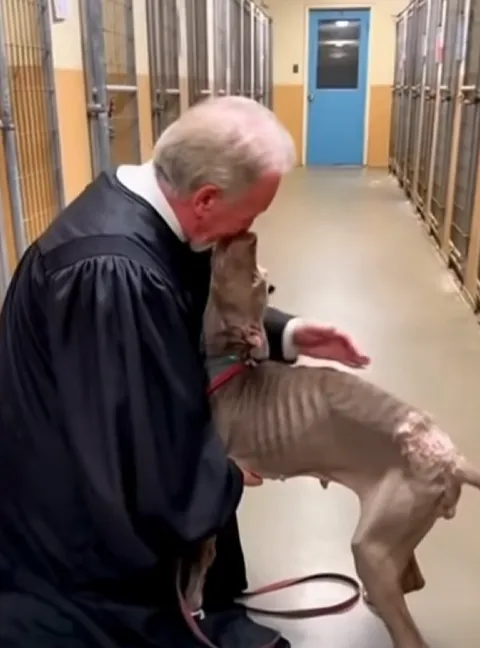
The dog struggled to his feet—shaking, stumbling—every bone visible beneath his fragile skin.
The vet tech took a step forward.
But Finn ignored her.
Instead, he took three trembling steps and collapsed gently into Judge Wallace’s lap.
The vet gasped.
“We’ve been trying for days,” she whispered. “He’s been too terrified to move toward anyone.”
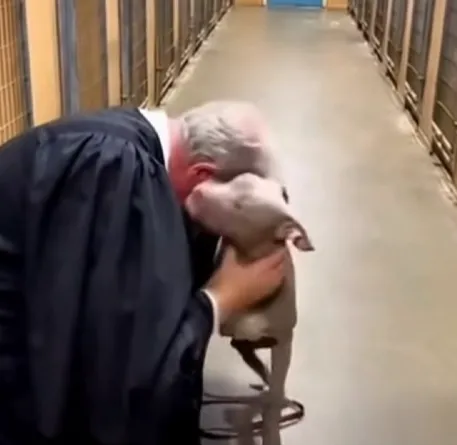
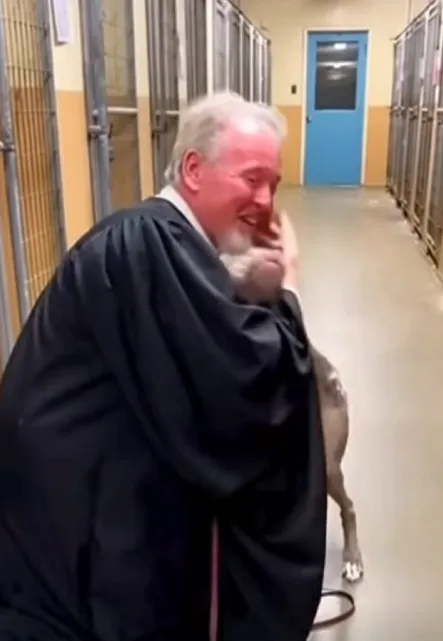
But now, Finn was pressing his face into the judge’s robes.
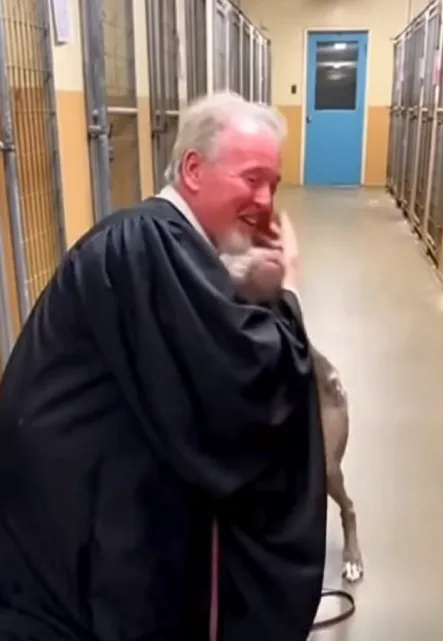
He sighed—a long, exhausted sigh—then began licking the tears from the man’s cheeks.
Tears that Judge Wallace hadn’t even realized were falling.
“I can’t get enough of him,” the judge said, voice breaking. “Just look at this face…”
He wrapped his arms around Finn—robe, reputation, and reserve forgotten.
“You’re safe now,” he whispered into the dog’s neck. “It’s all over, pal. You’re all right.”
For the first time since being rescued, Finn closed his eyes and fell asleep.
In the judge’s arms.
THE WEEKS THAT FOLLOWED
Judge Wallace returned to the shelter every week.
No cameras.
No staff escorts.
Just a quiet man and a recovering dog.
He brought soft blankets.
He read case files while Finn slept beside him.
He spoke softly, letting the dog learn what safety sounded like.
As Finn began to gain weight, the staff noticed he reacted differently to Judge Wallace than to anyone else. His tail wagged. His eyes followed him. His body relaxed in his presence.
It was as though Finn had chosen him long before either of them realized it.
And the judge had chosen him back.
THE DAY FINN WENT HOME
Two months later, the shelter finally cleared Finn for adoption.
They were overwhelmed with applications—people who had followed updates online, people who wanted to give him a happy ending.
But the shelter staff already knew who his family would be.
There was never any question.
When Judge Wallace walked through the door that day, Finn—now strong enough to stand without shaking—bolted across the room and leaped into his arms.
“Ready to go home?” the judge asked.
Finn licked his chin as if he already knew the answer.
The adoption papers were signed within minutes.
A once-abandoned dog, left for dead in a dark apartment, walked out through the front door of the shelter with his new owner:
A man who had sentenced his abuser…
But who saved him in a way no courtroom ever could.
THE LEGACY OF A JUDGE AND A DOG
In the courthouse, Judge Wallace’s reputation changed.
Not because he was less tough.
Not because he softened on crime.
But because everyone realized something:
Justice, at its heart, is an act of humanity.
And sometimes, humanity takes the shape of a skeletal pit bull crawling into the lap of the one man who refused to look away.
Finn became a local legend.
He visited schools with the judge.
He greeted courthouse staff every morning.
He slept beside the man who had once delivered justice from a bench—but now delivered comfort from a couch.
And Judge Wallace?
He continued issuing verdicts.
Continued protecting the vulnerable.
Continued being the stern, fair, unshakable pillar he had always been.
But from that day forward, everyone who entered his courtroom knew something else:
Behind the robe was a man who once held a dying dog in his arms…
…and decided justice wasn’t enough.
Compassion was required, too.
Because some victims never get to speak.
And that makes their rescuers all the more extraordinary.