Luke was born with bones that didn’t bend — joints that refused to move, limbs that twisted where they shouldn’t, and a spine that carried more fragility than any child’s should. From the moment he took his first breath, doctors knew his journey would be different. Words like
fusion, scoliosis, and surgery became part of his story before he even learned how to walk.
His parents remember those early years with a mix of fear and awe. They were told their little boy might never run, might never jump, might never know the freedom of movement most children take for granted. But what they didn’t tell them — what no doctor could have predicted — was the size of Luke’s heart.
Because where his bones were fused, his spirit was not.
Every challenge seemed to forge something stronger inside him — a determination that couldn’t be measured in medical charts or test results. Even as his body struggled to cooperate, Luke’s eyes shone with a quiet confidence that said,
I can do this.
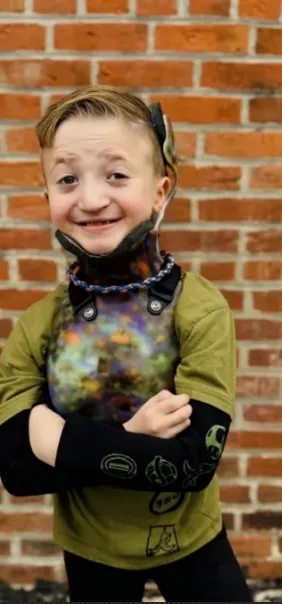
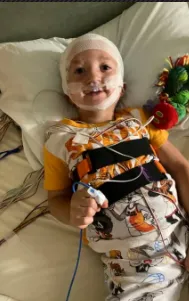
By the time he was ten, Luke had already endured more surgeries than most people face in a lifetime. Each one came with new hope and new pain — recovery rooms filled with beeping machines, whispered prayers, and the soft squeeze of his parents’ hands. But none of those moments prepared them for what came next.
During a routine scan last year, doctors found something they feared most: a dangerous complication in Luke’s upper spine. The bones that should have protected his spinal cord were instead pressing dangerously close to it — so close that one wrong move, one fall, one unlucky twist, could leave him
paralyzed.
The news hit like a storm.
For weeks, his parents tried to process it, caught between fear and disbelief. Luke, though, listened carefully as the doctors explained what was happening. He didn’t cry. He didn’t flinch. Instead, he asked one simple question:
“So… when do we fix it?”
That was Luke — steady, fearless, already planning his comeback before the battle even began.
The surgery was scheduled for Halloween. While other kids were dressing up as superheroes, Luke was becoming one in the truest sense. The operation would last
thirteen hours, a delicate fusion of bones and metal rods to stabilize his neck and spine. The risks were enormous, but so was the need to act.
The night before surgery, his mom tucked him into his hospital bed, trying not to let him see her tears. “You’re so brave,” she whispered.
He smiled, his voice small but full of faith. “Don’t worry, Mom. I’ll get back up.”
The next day stretched longer than anyone could bear. Thirteen hours of silence, broken only by the sound of pacing feet and whispered prayers. When the surgeon finally emerged, exhaustion in his eyes but relief in his tone, he said the words they’d been waiting for:
“He made it through. He’s stable.”
When Luke finally woke, his body was wrapped in bandages, his neck supported by a brace that would stay for months. Every breath hurt, every movement burned. But when his parents leaned close to him, he smiled weakly and whispered, “I told you I’d get back up.”
And he did.
The road to recovery was long, grueling, and often unfair. Physical therapy became his battlefield — a place where tears and triumph lived side by side. At first, even sitting upright felt impossible. The pain radiated through his back like fire, and every inch of progress demanded more strength than most adults could imagine.
But Luke didn’t stop.
Each day, he pushed a little harder. Each session, he moved a little further. His therapists learned quickly that this boy wasn’t motivated by pity — he was motivated by
possibility.
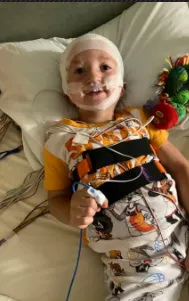
When they asked him what he wanted to do first once he recovered, his answer came without hesitation:
“I want to walk out onto the football field.”
Football had always been his favorite — not because he could play, but because he loved the energy, the teamwork, the spirit of it. He watched his local team faithfully, memorizing every play, cheering louder than anyone in the stands. For him, football wasn’t just a sport. It was hope — the reminder that even when you’re knocked down, you get back up.
And that became his mission.
For months, he worked toward that single goal. Every stretch, every step, every grimace of pain brought him closer. His family hung his favorite quote on the wall above his bed — words that came from his favorite song,
“Up” by Andy Grammer:
I’ve been knocked down, but I’ll get up again.
It became his anthem.
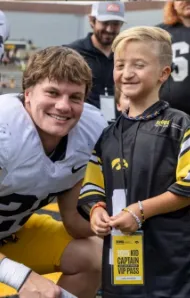
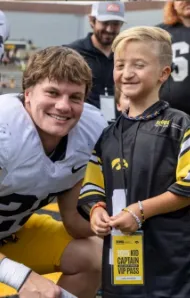
When the day finally came — nearly a year after that life-changing surgery — Luke stood tall on the football field, dressed in his team’s jersey, beaming with pride. He wasn’t there as a patient this time. He was there as the
Kid Captain.
The stands erupted with cheers as the announcer shared his story. The same boy who once faced the possibility of paralysis was now standing strong before thousands, his heart pounding in time with the music that filled the stadium.
And then, as if the universe itself wanted to celebrate him, the opening chords of “Up” began to play.
Luke looked out across the field, eyes shining under the bright lights. His parents stood nearby, tears streaming down their faces. He wasn’t just standing — he was
rising.
In that moment, the pain, the surgeries, the sleepless nights — they all faded into something greater. He wasn’t defined by what had been broken, but by what had been rebuilt.
He had kept his promise.
He got back up.
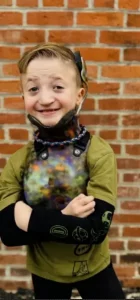
Now, when people see Luke, they don’t just see scars or braces. They see a story — one written in resilience, one that says courage isn’t the absence of fear but the choice to face it anyway.
He still has challenges ahead — checkups, therapy, a lifetime of careful movement — but his spirit is stronger than any bone in his body.
His favorite part of that night wasn’t the applause or the lights. It was the way the music made him feel — free, alive, unstoppable. “That song,” he said later, “it’s not just music. It’s me.”
Because for Luke, Up isn’t just a song.
It’s his heartbeat.
It’s his journey.
It’s his way of telling the world that no matter how hard life tries to hold you down — you can rise again.
And this time, as he stood proudly on the field, with thousands cheering and his anthem soaring through the night, Luke did more than just get back up.
He rose higher than ever before.