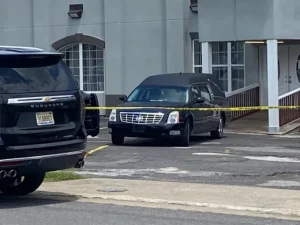
The discovery of a young child’s lifeless body at the West Gadsden Funeral Home in the early hours of Saturday, August 9, 2025, marked the beginning of a tragic story that has shaken the community of Gadsden, Alabama, and the world. It began when employees, returning from a routine call, walked past a hearse, where they initially thought they had spotted a doll—an odd sight, but nothing to raise alarm. However, their instincts led them to open the door, and what they found inside was not a toy, but the body of one-year-old Blessence Pearl.
Blessence, a baby girl just beginning to walk, should have been cradled safely in the arms of someone who loved her, not discovered in the back of a hearse, left to a tragic and untimely death. The employees who found her were faced with a haunting reality that would leave them forever marked by what they saw that day. The stillness of the tiny body, placed in a vehicle meant to carry the dead, instantly told them that something was terribly wrong.

It was a scene that no one in the funeral home was prepared for. Owner Dantez Robinson later shared the moment with a voice still shaken, recalling the call he received from an employee. “They said they found an infant baby inside one of the hearses,” Robinson recalled. “I was in shock.” The question hung in the air, unanswered—how had this baby ended up there? What had happened in the hours before her discovery?
The truth, when it came, was more devastating than anyone could have imagined. Autopsy reports revealed that Blessence had been strangled with a thick robe string—a senseless act of violence. The Gadsden Police Department quickly launched an investigation, and within 12 hours, the case took a turn no one expected. The mother of Blessence, 25-year-old Terica Pearl, was arrested and charged with capital murder. It was a blow that rocked the community—how could the person who was supposed to protect this precious child have been the one to end her life?

As the investigation unfolded, the details surrounding Blessence’s final hours emerged. Blessence’s mother, who had been living with her boyfriend Daniel Martell, was reported to have been involved in a heated argument prior to the child’s death. The violence was horrific, the grief palpable. And as the arrest was made, Gadsden became a place of mourning, not just for the loss of a child, but for the broken trust between mother and daughter, a bond that should have been a source of safety, but instead turned into an instrument of horror.
The arrest of Terica Pearl sent shockwaves through the small community. Neighbors, friends, and family members were left stunned, struggling to comprehend how such a tragedy could have unfolded. Many spoke in hushed tones about the events leading up to that fateful day, some in disbelief, others consumed by a grief they couldn’t explain. The pain was not just personal—it was communal. In a town where families know each other, where children play in the streets and laughter is shared between neighbors, the loss of a life so young, so full of promise, left a deep scar.

Gadsden Mayor Craig Ford addressed the media, expressing the weight of the situation. “This was a tough case for everybody involved,” he said. “I’m proud of the way our police department went after the truth and got it done. An arrest doesn’t take away the hurt, but it does mean we’re one step closer to justice for this child.”
While justice is crucial, it feels like a hollow victory in the face of such senseless loss. How does one reconcile a tragedy like this with the everyday routines of life? How can any system of justice ever make up for the loss of a child, the loss of innocence, the loss of a future that will never be lived?

The funeral home employees who found Blessence Pearl have struggled with the emotional toll of the discovery. Many have reported sleepless nights, their minds replaying the moment they opened the hearse door and saw her lifeless form. They wonder about her last moments. Was she scared? Was she crying for someone to help her? The unanswered questions weigh heavily, and no answer will ever truly bring peace.
In the days following the discovery, the community rallied in support of the family, lighting candles and placing stuffed animals at the gates of the funeral home. Vigils were held, and prayers were said for Blessence’s memory. Strangers wept for a little girl they would never meet, but whose story touched their hearts. Her tragic end was a reminder of the preciousness of life, the vulnerability of children, and the responsibility we all have to protect them.
Though her life was stolen too soon, Blessence’s memory lives on in the outpouring of support and the calls for justice. A preliminary hearing was set for her mother, and as the court proceedings begin, the community continues to search for answers. The questions still linger—how did this happen? What could have been done to prevent it? And most haunting of all: How could a mother, a person who should have protected her child, have caused such unimaginable harm?
The story of Blessence Pearl is more than just a police case—it’s a poignant reminder of the responsibility we all bear to safeguard the innocent. It’s a reminder that, while justice is necessary, prevention is priceless. No parent should ever have to bury their child. No community should ever have to endure such pain. And no child should ever be taken from this world before they have a chance to live, to learn, and to love.
Blessence Pearl’s light may have been extinguished far too soon, but her memory, fragile yet powerful, will not be forgotten. Every candle lit, every prayer said, and every tear shed in her name helps to carry her legacy forward. She deserved a lifetime of love and laughter, and though that was taken from her, her story will continue to inspire those who hear it.