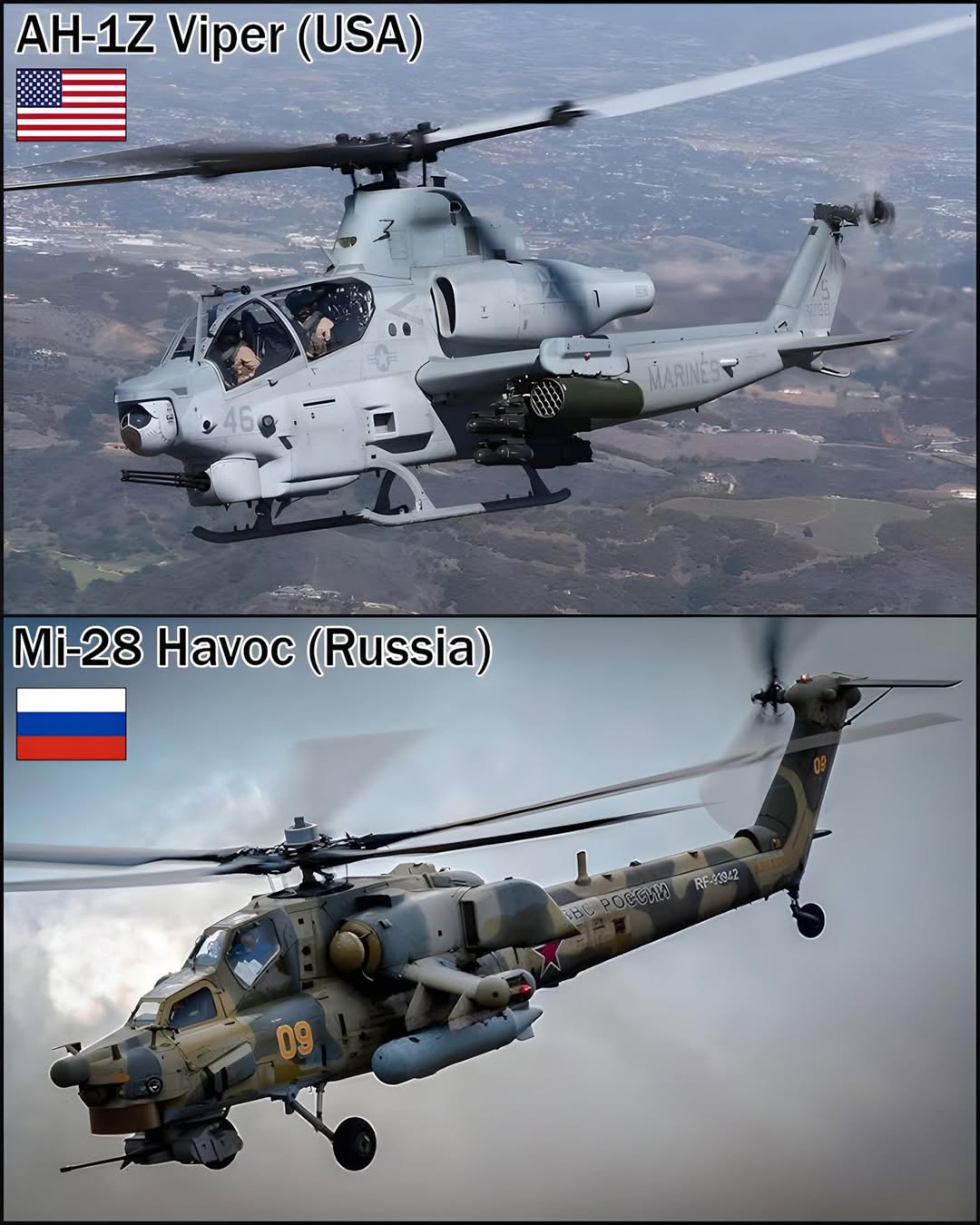
The AH-1Z Viper from the United States and the Mi-28 Havoc from Russia are two of the world’s most prominent attack helicopters. Both are designed for close air support, anti-armor missions, and battlefield reconnaissance, yet they reflect distinctly different design philosophies and operational priorities.
1. Design and Airframe
The AH-1Z Viper features a twin-engine, tandem-seat layout with a slim, streamlined fuselage optimized for speed, agility, and a reduced radar signature. Advanced composite materials reduce weight while enhancing survivability, and retractable landing gear alongside modular weapon pylons provide operational flexibility. In contrast, the Mi-28 Havoc has a twin-engine, tandem cockpit with an armored cabin for pilot and gunner protection. Its bulkier, heavier airframe prioritizes survivability and ruggedness. Fixed landing gear and integrated sensor turrets make the Mi-28 less aerodynamic than the Viper but highly durable for harsh battlefield conditions.
2. Avionics and Targeting Systems
The Viper is equipped with the Target Sight System (TSS), offering thermal imaging, laser designation, and day/night targeting capabilities. Its integrated glass cockpit and advanced mission computers enhance situational awareness and networked warfare capabilities. The Mi-28, meanwhile, relies on radar and optical-electronic targeting systems for all-weather, day/night operations. Its cockpit instrumentation emphasizes battlefield resilience; while technologically capable, it is generally less integrated than Western glass cockpits. The Russian design prioritizes direct combat survivability over networked integration.
3. Armament
The AH-1Z Viper mounts a 20mm M197 three-barrel Gatling gun on the chin turret and can carry AGM-114 Hellfire missiles, Hydra 70 rockets, and Stinger air-to-air missiles. Its versatile weapons suite allows rapid reconfiguration depending on mission requirements. The Mi-28 Havoc, by comparison, is armed with a 30mm Shipunov 2A42 autocannon under the nose, capable of firing high-explosive and armor-piercing rounds, alongside Ataka anti-tank missiles and S-8 rockets. Its heavier ordnance payload emphasizes firepower, particularly against armored targets.
4. Performance
The Viper reaches a maximum speed of approximately 315 km/h (196 mph) with a range of about 570 km (354 miles). Its agility and low-altitude maneuverability make it highly effective in close support and hit-and-run missions. The Mi-28 has a slightly lower top speed of 300 km/h (186 mph) and a shorter range of 435 km (270 miles). Its heavier design sacrifices some agility but provides greater survivability under fire.
5. Operational Philosophy
The AH-1Z Viper is designed for networked modern warfare, rapid deployment, and operational flexibility. It balances survivability, agility, and precision engagement, thriving in environments where speed, sensor integration, and precision strikes are critical. The Mi-28 Havoc, by contrast, is built for ruggedness, heavy firepower, and resilience in contested environments. Russian design philosophy emphasizes armored protection, reliable weaponry, and battlefield durability over sophisticated avionics.
Conclusion
Both helicopters are highly capable, but they excel in different areas. The AH-1Z Viper prioritizes agility, advanced sensors, and mission adaptability, making it ideal for U.S. Marine Corps rapid-response operations. The Mi-28 Havoc, with its heavier armor and formidable weapons load, reflects a Russian focus on survivability and direct battlefield dominance. Choosing between them depends largely on operational doctrine, terrain, and intended combat roles.