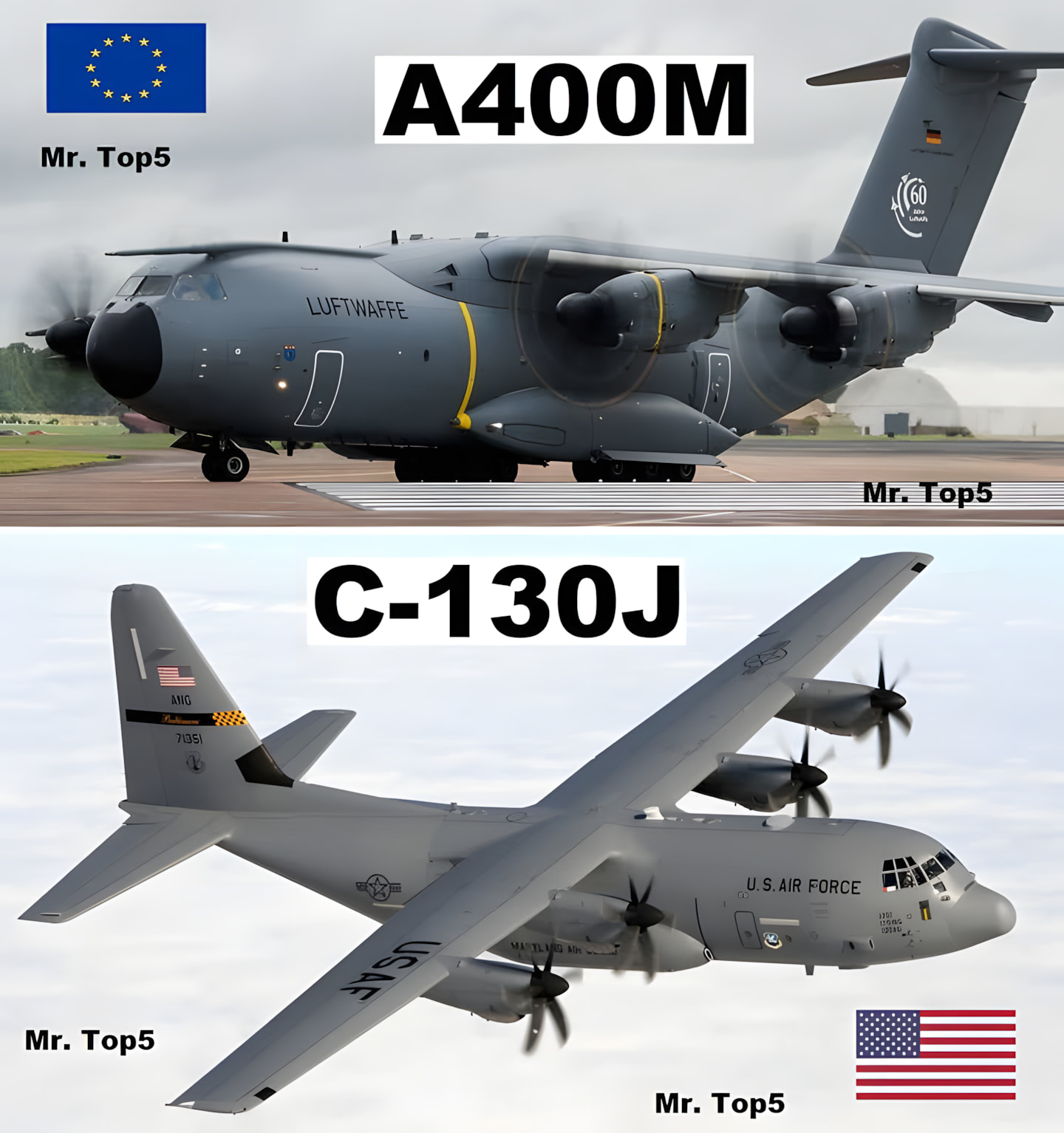
The Airbus A400M and the Lockheed Martin C-130J Super Hercules are two of the most prominent tactical military transport aircraft in use today. Both aircraft serve a similar purpose—strategic and tactical airlift—but differ significantly in capabilities, design, and operational roles.
1. Origin and Development
-
A400M: Developed by Airbus Military (now Airbus Defence and Space), the A400M was designed to bridge the gap between strategic airlifters like the C-17 and tactical transports like the C-130. It first flew in 2009 and entered operational service in 2013.
-
C-130J: The C-130J Super Hercules is the latest variant of the legendary C-130 Hercules family, first introduced in the 1950s. The J-model incorporates modern avionics, more powerful engines, and improved efficiency, and has been operational since 1999.
2. Size and Payload
-
A400M: With a maximum payload of around 37 tonnes (81,600 lbs), the A400M can carry heavy and oversized equipment such as helicopters, armored vehicles, and large containers. Its cargo hold is 17.7 m long, 4 m wide, and 3.85 m high.
-
C-130J: The C-130J carries up to 20 tonnes (44,000 lbs) of cargo. Its cargo bay is 12.5 m long, 3.12 m wide, and 2.74 m high. While smaller than the A400M, the C-130J is highly versatile and can operate from shorter, unprepared airstrips.
3. Performance and Range
-
A400M: Powered by four turboprop engines, the A400M can reach a maximum speed of 780 km/h (485 mph) and a range of 3,300 km with maximum payload, extendable with aerial refueling. Its high-speed, long-range capability allows it to perform both tactical and strategic missions.
-
C-130J: The C-130J has a top speed of around 671 km/h (417 mph) and a range of approximately 3,300 km with max payload. While slower than the A400M, it excels in operations from rough, short airfields and in low-altitude tactical missions.
4. Operational Flexibility
-
A400M: Designed for multi-role operations, the A400M can perform strategic airlift, tactical airlift, medical evacuation, aerial refueling, and paratrooper deployment. Its size allows it to carry more diverse and heavier loads.
-
C-130J: Known for its ruggedness, the C-130J is ideal for tactical operations such as troop insertion, cargo drops, humanitarian missions, and even special operations. Its proven ability to operate in austere environments remains unmatched.
5. Cost and Logistics
-
A400M: Significantly more expensive, both in unit cost (~€150 million per aircraft) and maintenance. Requires more advanced infrastructure due to its size and weight.
-
C-130J: Cheaper (~$70 million per aircraft) and logistically easier to deploy. Its decades-long operational history ensures mature maintenance procedures and global availability of spare parts.
6. Summary and Suitability
The A400M and C-130J occupy different niches within military air transport:
-
A400M: Best for nations needing heavy-lift strategic airlift, able to transport large vehicles, helicopters, or oversized cargo over long distances.
-
C-130J: Ideal for tactical, flexible operations requiring short-field takeoffs, austere airstrip landings, and rapid deployment of troops and equipment.
In conclusion, the A400M complements the C-130J rather than replaces it. While the A400M dominates in payload and speed for strategic missions, the C-130J remains unmatched in tactical versatility, ruggedness, and operational economy. Militaries often operate both types to achieve a balanced airlift capability across different mission profiles.