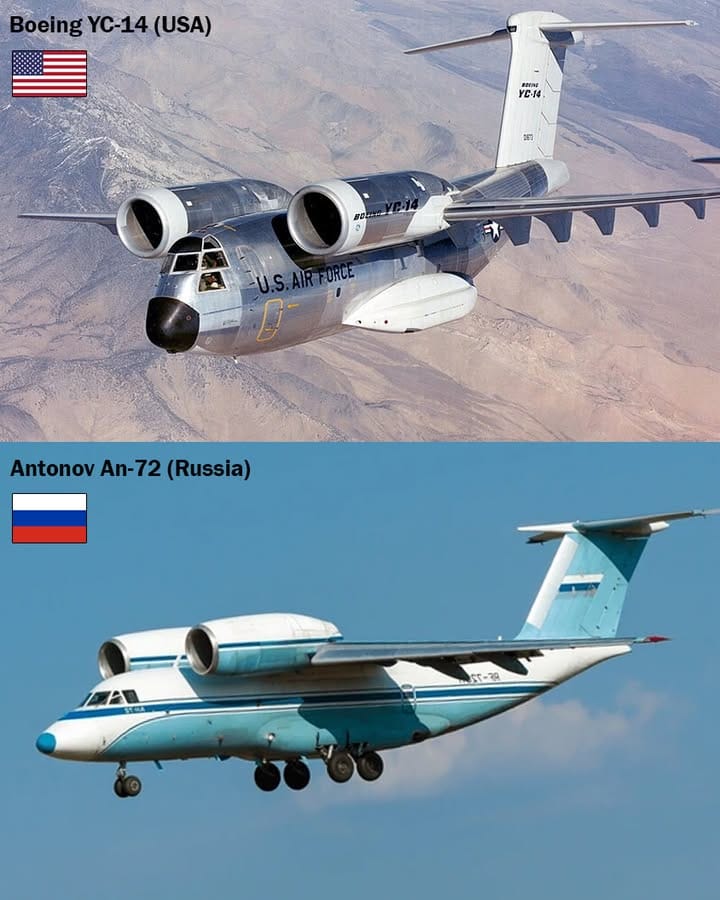
The aviation world has witnessed remarkable innovation in aircraft design, particularly in the pursuit of Short Take-Off and Landing (STOL) capabilities. Among these innovations, two aircraft stand out due to their unique approach to aerodynamics and engine placement: the Boeing YC-14 from the United States and the Antonov An-72 from Russia. Despite originating from vastly different contexts and aerospace traditions, both aircraft share a key design philosophy—over-wing engine placement—underscoring the strategic importance of maximizing lift and operational flexibility.
Origins and Design Intent
The Boeing YC-14 emerged in the early 1970s as part of the United States Air Force’s Advanced Medium STOL Transport (AMST) program. Its primary objective was to replace older tactical airlift aircraft, offering enhanced STOL performance while maintaining comparable payload capacity to larger transport aircraft. The YC-14 leveraged over-wing engine placement to exploit the Coandă effect, wherein engine exhaust is directed over the wing’s upper surface, increasing lift at low speeds—a critical factor for short runway operations.
Meanwhile, the Antonov An-72, first flown in 1977, represents a parallel development from the Soviet Union. Designed primarily for cargo transport in Arctic and unprepared airstrips, the An-72 similarly utilizes over-wing engines to enhance lift, allowing it to operate from austere environments that would challenge conventional transport aircraft. While the YC-14 was developed with high-speed tactical performance in mind, the An-72 prioritized operational versatility and ruggedness, reflecting the distinct strategic needs of Soviet aviation.
Aerodynamic Innovation: Over-Wing Engine Placement
Both aircraft exploit the aerodynamic benefits of over-wing engine configuration, though with nuanced differences. By positioning the engines atop the wing, designers harness the high-velocity exhaust to flow directly over the upper surface, energizing the boundary layer and delaying flow separation. This mechanism effectively increases lift during takeoff and landing phases, a critical requirement for STOL operations. Additionally, over-wing placement reduces the risk of foreign object ingestion during operations on unpaved or debris-laden runways—a practical consideration in both military and remote-area transport missions.
The YC-14 employs a twin-engine, high-bypass turbofan configuration mounted close to the fuselage, enabling the aircraft to achieve remarkable lift augmentation without significantly compromising aerodynamic efficiency. The An-72, in contrast, uses a pair of D-36 turbofan engines mounted above the wing’s forward section, angled slightly outward. This configuration not only enhances lift but also provides inherent short-field performance in extreme climates and challenging terrains, a testament to the Soviet focus on versatility.
Operational Implications and Legacy
Despite their shared STOL-focused design philosophy, the operational histories of the YC-14 and An-72 diverge. The YC-14, although technologically advanced, was ultimately not adopted for mass production due to shifts in U.S. Air Force priorities and competition from other transport aircraft concepts, such as the C-17. Conversely, the An-72 became a mainstay in Soviet and later Russian aviation, valued for its ability to operate in remote regions and harsh climates, and spawning derivatives like the An-74, further extending the utility of the over-wing engine concept.
In conclusion, the Boeing YC-14 and Antonov An-72 exemplify how similar aerodynamic principles—over-wing engine placement to boost STOL performance—can be applied in distinct geopolitical and operational contexts. While the YC-14 represents a pinnacle of American experimental aviation with limited operational deployment, the An-72 demonstrates how practical design adaptations can result in enduring versatility. Together, they highlight the ingenuity and adaptability inherent in aerospace engineering, reminding us that even divergent aviation traditions can converge on similar solutions when confronting shared aerodynamic challenges.