1. Introduction

The Sukhoi Su-30 and the Boeing F/A-18E/F Super Hornet represent two distinct philosophies in modern air combat design — Russian emphasis on agility and range, versus American focus on carrier-based versatility and advanced avionics. Both fighters serve as backbone platforms for their respective air forces and navies, evolved from Cold War-era doctrines into multi-role precision assets in the 21st century.
2. Design Philosophy
🇷🇺 Su-30 Flanker
-
A twin-engine, twin-seat heavy fighter derived from the Su-27.
-
Emphasizes long-range, high-maneuverability, and multi-role strike capabilities.
-
Built for dominance in both air superiority and precision strike roles, often supported by advanced radars and electronic warfare (EW) variants (e.g., Su-30SM, Su-30MKI).
🇺🇸 F/A-18E/F Super Hornet
-
A carrier-capable, twin-engine multirole fighter.
-
Prioritizes versatility, networked warfare, and reliability in hostile maritime and land environments.
-
Features stealth-inspired design elements, advanced radar, and modular avionics for easy upgrades.
3. Airframe and Performance
| Specification | Su-30 Flanker | F/A-18E/F Super Hornet |
|---|---|---|
| Max Speed | Mach 2.0+ | Mach 1.6+ |
| Combat Range | ~1,500 km (unrefueled) | ~1,280 km (with external tanks) |
| Service Ceiling | ~17,300 m (56,800 ft) | ~15,000 m (50,000 ft) |
| Thrust Vectoring | Yes (on some variants, e.g., Su-30MKI) | No |
| Takeoff Platform | Ground-based | Carrier-based (CATOBAR) |
✈️ Analysis:
-
The Su-30 has greater range, speed, and altitude performance, making it ideal for wide territorial coverage and deep strike roles.
-
The Super Hornet trades range for carrier operability, survivability, and modular adaptability.
4. Avionics and Radar Systems
🔎 Su-30 (varies by variant)
-
Radar: N011M Bars (PESA) or IRBIS-E (on later variants)
-
IRST (Infrared Search and Track): Standard on most Su-30s
-
EW Systems: Varies by variant; India’s MKI has Israeli/Russian hybrid EW
-
Cockpit: Analog-digital mix (older); fully glass cockpit (modern SM2/MKI variants)
🔎 F/A-18E/F Super Hornet
-
Radar: AN/APG-79 AESA (Active Electronically Scanned Array)
-
IRST: Optional pod or built-in on Block III
-
EW Systems: AN/ALQ-214 IDECM, advanced jammers
-
Cockpit: Digital glass cockpit with touchscreen (Block III upgrade)
🧠 Analysis:
-
Super Hornet benefits from cutting-edge AESA radar and EW integration, giving it superior sensor fusion and networked situational awareness.
-
Su-30 relies on powerful radar and IRST for long-range detection and passive engagement — especially effective in environments with heavy jamming.
5. Weapons Load and Combat Roles
| Su-30 Flanker | F/A-18E/F Super Hornet | |
|---|---|---|
| Hardpoints | 12 | 11 |
| Max Payload | ~8,000 kg | ~8,050 kg |
| Air-to-Air Missiles | R-77, R-73, R-27, Astra (India) | AIM-120 AMRAAM, AIM-9X |
| Air-to-Ground | Kh-29, Kh-31, Kh-59, guided bombs | JDAM, JSOW, SLAM-ER, AGM-88 HARM |
| Naval Weapons | Kh-31A (anti-ship), BrahMos (India) | Harpoon, LRASM (on some units) |
| Gun | GSh-30-1 30mm | M61A2 Vulcan 20mm |
-
Su-30: Long-range interception, strike missions, anti-ship roles, and heavy payload flexibility.
-
Super Hornet: Precision strike, SEAD (Suppression of Enemy Air Defenses), maritime operations, and force projection from aircraft carriers.
6. Maneuverability and Combat Tactics
🌀 Su-30
-
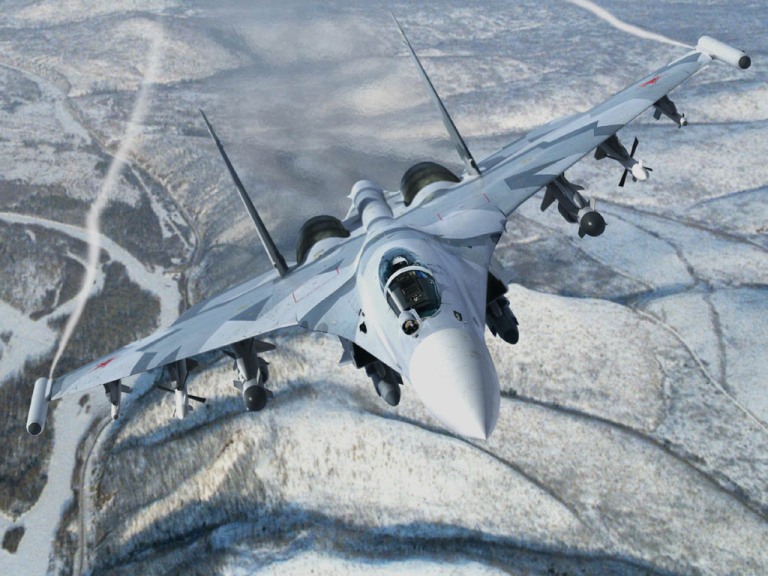
Equipped with thrust vectoring nozzles (on Su-30MKI, SM2), enabling extreme post-stall maneuvers like the Cobra and Kulbit.
-
Excels in dogfighting and visual-range combat, especially when paired with R-73 and helmet-mounted sights.
🌀 F/A-18E/F
-
Highly agile in subsonic flight with strong nose authority and carrier-landing control.
-
Superior BVR (Beyond Visual Range) combat effectiveness due to radar, AIM-120D, and networking with AWACS/F-35.

7. Operational Use and Combat History
🇷🇺 Su-30
-
Widely exported (India, China, Venezuela, Algeria, etc.)
-
Su-30 variants have seen combat in Syria, Ukraine, and border skirmishes with Pakistan.
-
Forms the aerial backbone of many non-Western air forces.
🇺🇸 F/A-18E/F
-
Flies from U.S. Navy aircraft carriers around the world.
-
Extensively used in Iraq, Afghanistan, Syria, and Pacific deterrence missions.
-
Core element of U.S. carrier air wings, often paired with EA-18G Growler for electronic warfare.
8. Strengths and Weaknesses
| Aspect | Su-30 Flanker | F/A-18E/F Super Hornet |
|---|---|---|
| Strengths | Superior maneuverability, range, payload | Advanced radar, carrier-capable, reliable |
| Weaknesses | Heavier, older avionics (some variants) | Less range, lower top speed |
| Upgrade Path | Su-30SM2 (Russia), Super Sukhoi (India) | Block III upgrade, conformal fuel tanks, IRST |
9. Conclusion
The Su-30 and F/A-18E/F reflect divergent tactical doctrines:
-
The Su-30 is a long-range, maneuverability-focused interceptor-strike hybrid ideal for vast land-air battlespaces.
-
The Super Hornet is a carrier-based, multi-mission networked platform, optimized for joint operations and electronic warfare.
In a head-to-head, the Su-30 may dominate in close-range dogfights and raw kinematic performance, while the Super Hornet likely wins in BVR engagements, sensor fusion, and naval warfare integration — especially when supported by U.S. carrier strike groups.