At Zoo Atlanta, thousands of visitors pass by the gorilla habitat each year expecting to be impressed by size, strength, or dramatic displays of power. Instead, many find themselves stopping mid-step for a far quieter reason: a gorilla’s hands.
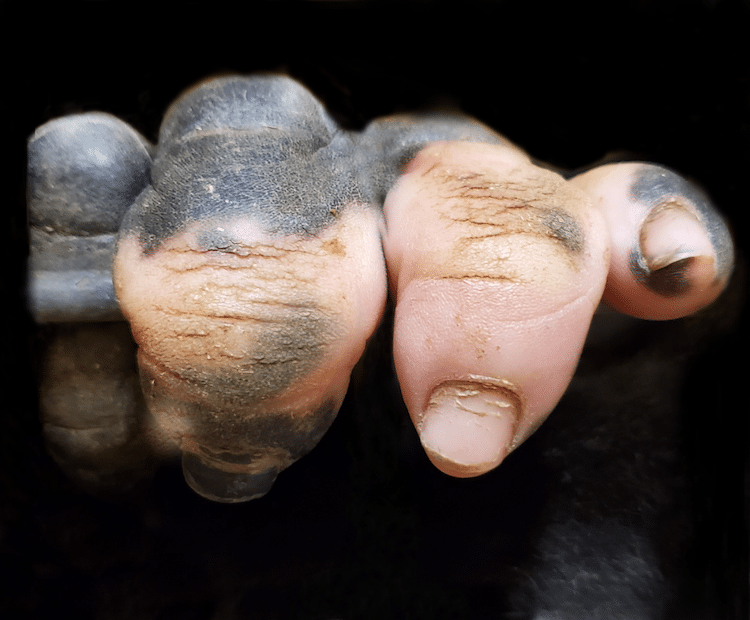
She does not shout, charge, or demand attention. She simply rests her hands against the glass or the ground, and people notice something unexpected. On several of her fingers, the skin fades into a soft, pale pink, nearly identical to human fingertips.
Against her dark fur, the contrast is striking. Visitors often pause, lean closer, and do a double-take, momentarily unsure where the gorilla ends and something deeply familiar begins. It is not fear that stops them, but recognition.
Zookeepers are quick to explain that this feature is entirely natural. Gorillas, like humans, display variation in skin pigmentation. Genetics, friction, age, and even minor scarring can cause lighter patches to appear on palms, noses, toes, or fingers.
From a biological perspective, there is nothing unusual about pink fingertips on a gorilla. From a human perspective, however, the effect is profound. Seeing human-like skin on an animal already known for expressive gestures creates a powerful emotional response.
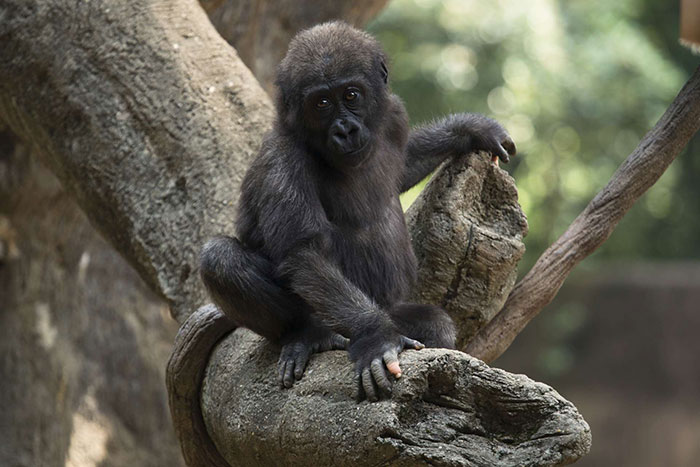
Gorillas belong to the species Western lowland gorilla, which shares approximately 98 percent of its DNA with humans. That genetic closeness is often cited in textbooks, documentaries, and museum plaques, but it can feel abstract until a moment like this.
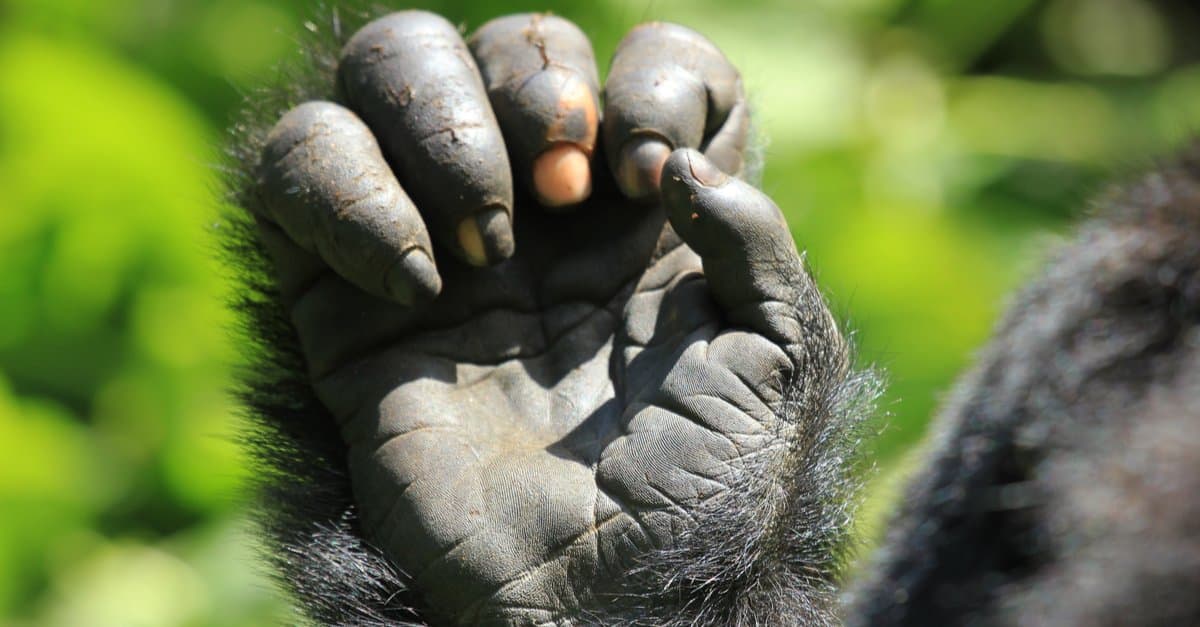
Hands are deeply personal to humans. They are how we comfort, create, work, and connect. When a gorilla raises a hand with fingertips that look startlingly familiar, the shared evolutionary history suddenly becomes visible.
Visitors describe the moment as unsettling in the best possible way. The pink fingertips do not make the gorilla seem less wild, but more real. They collapse the imagined distance between species, replacing it with something intimate and undeniable.
Evolutionary biologists explain that pigmentation differences are governed by melanin distribution, which varies widely among primates. In gorillas, areas with frequent contact or pressure can naturally appear lighter over time, much like calluses or worn skin in humans.
Yet science alone does not explain why the sight resonates so deeply. The gorilla’s hands do not just resemble ours anatomically, with five fingers, nails, and flexible joints. They mirror our vulnerability, our dexterity, and our capacity for touch.
Gorillas use their hands to groom one another, cradle infants, forage for food, and communicate subtle emotional cues. These behaviors, observed daily by keepers, closely parallel human social bonding and caregiving.
At Zoo Atlanta, caretakers emphasize education through observation rather than spectacle. Moments like these, they say, often leave a stronger impression than signs or lectures ever could.
Children press their hands against the glass, instinctively comparing fingers. Adults fall silent, absorbing the quiet realization that the boundary between “us” and “them” is thinner than they imagined.
The pink fingertips become a conversation starter about conservation. Western lowland gorillas are critically endangered in the wild due to habitat loss, poaching, and disease. Every reminder of their closeness to us underscores what is at stake.
When people recognize gorillas as relatives rather than curiosities, empathy follows. Conservation stops being an abstract cause and becomes a moral responsibility toward family.
Zoos play a complex role in this story. While debates about captivity continue, accredited institutions like Zoo Atlanta focus heavily on conservation, research, and public education. The goal is not entertainment, but connection.
That connection is often formed through small, unexpected details. Not through dramatic encounters, but through quiet observations that bypass logic and speak directly to instinct.
The gorilla with pink fingertips does not know she is teaching a lesson. She does not understand the ripple effect of visitors walking away changed. She simply exists, unaware that her hands are challenging assumptions millions of years old.
Evolution is often presented as charts, fossils, and timelines. In this moment, it is tactile. It is visible. It is standing a few feet away, resting its fingers against the glass.
People leave the enclosure talking more softly. Some glance at their own hands as they walk away. Others search online later, reading about primate genetics and conservation efforts they had never considered before.
A single detail, barely noticeable at first glance, has done what pages of text often fail to achieve. It has made evolution personal.
The pink fingertips do not suggest that gorillas are becoming human. They remind us that humans never stopped being part of the same family tree.
In a world that often emphasizes division, this gorilla offers a quiet correction. She does not demand attention or admiration. She simply holds out her hand and reminds us who we are connected to.
Sometimes, the most powerful truths are found not in grand gestures, but in the smallest details. At Zoo Atlanta, that truth lives in a gorilla’s fingertips, softly pink against dark fur, waiting for someone to notice.