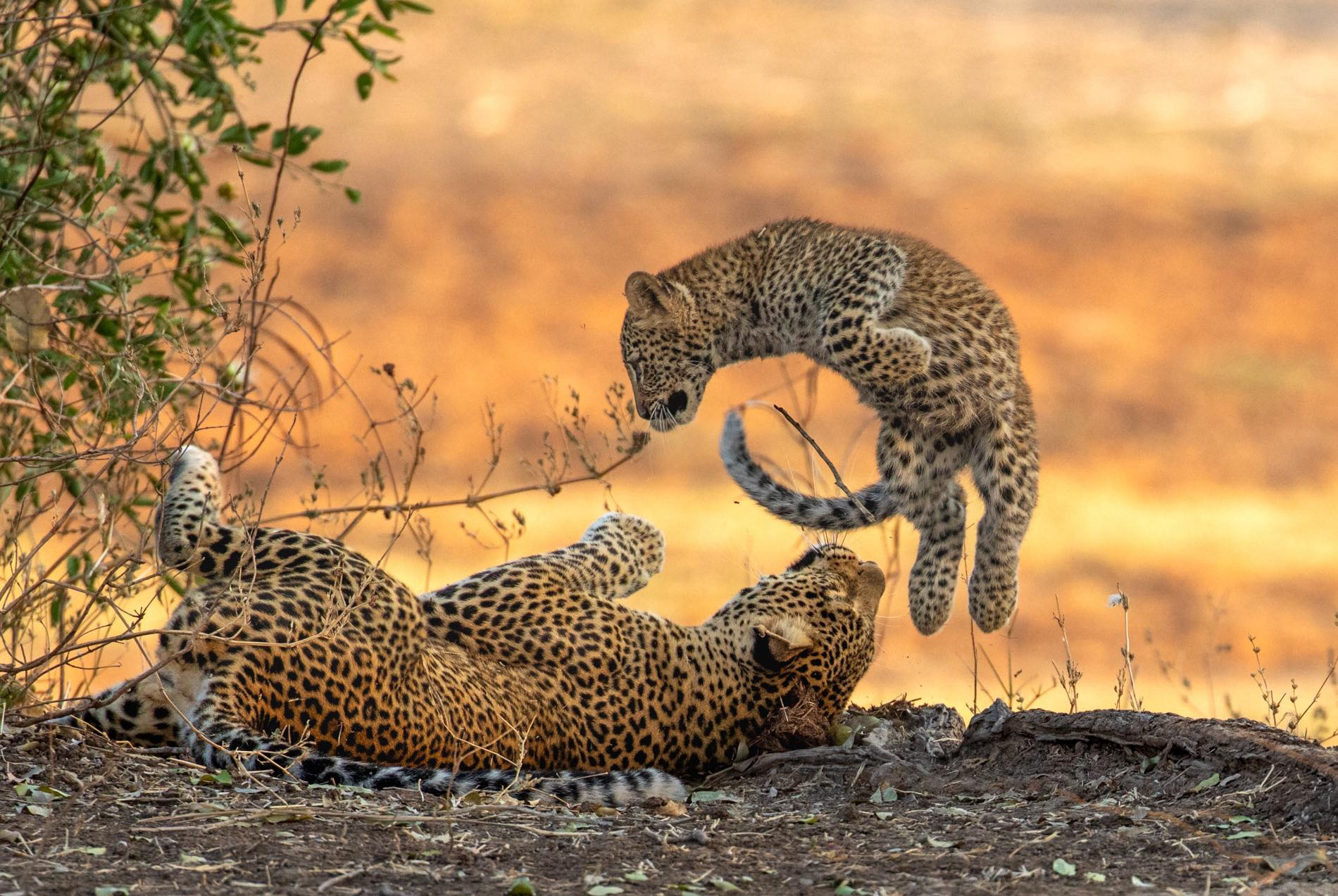
The sun hangs low over the African savanna, casting a molten-gold glow across the dry grasslands. In this golden hour, shadows stretch long and the air hums with the distant calls of birds settling for the evening. Amid this serene backdrop, a flash of movement breaks the stillness — a young leopard, all paws and curiosity, launches into the air.
Its body arcs perfectly, paws outstretched and tail curled in mid-flight, a picture of raw energy and untamed grace. Below, stretched out on her back in the dust, the mother leopard watches with unblinking eyes. Her gaze is a blend of patience, calculation, and something gentler — pride. She does not move to block or to swat, for this is a dance she knows well.
To the casual observer, it might look like nothing more than a playful leap. But in the wild, such games are never just games. Every airborne twist, every well-timed dodge is part of an unspoken curriculum. Here, in the open classroom of the bush, lessons are taught in silence: how to stalk without being seen, how to strike with precision, how to read the movements of prey — and of danger.
The cub lands, tumbles, and pounces again, its tiny muscles already learning the mechanics of the hunt. The mother responds with measured nudges and evasive rolls, never too easy, never too hard. In this way, the knowledge of generations is passed down, not in words, but in instinct.
The scene unfolds against a canvas of amber light and whispering leaves, timeless in its simplicity and profound in its purpose. For a brief moment, we are given a glimpse into the private world of one of nature’s most elusive predators — a world where survival is taught not through fear, but through the joy of the leap.
Even in the lives of the fiercest hunters, tenderness has its place. And in the fading light of the savanna, a mother’s patience becomes her cub’s greatest inheritance.