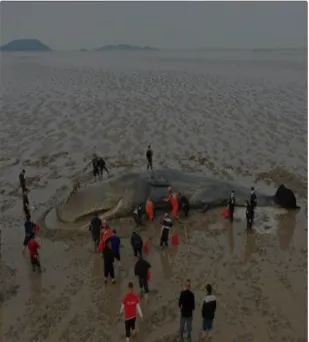
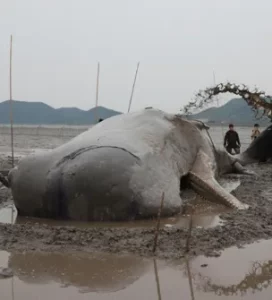
It was a tense morning in Ningbo, a coastal city south of Shanghai, when a shocking sight appeared on the beach: a massive sperm whale, stranded and struggling, its enormous body sprawled helplessly across the sand. At 65 feet long and weighing nearly ten tons, this gentle giant was in serious danger. Though whales breathe air, they are creatures built for the ocean; the cool water supports their massive bodies and regulates their temperature. On land, under the sun’s glare, the whale risked overheating, collapse, and even death if the tide rose and covered its blowhole.
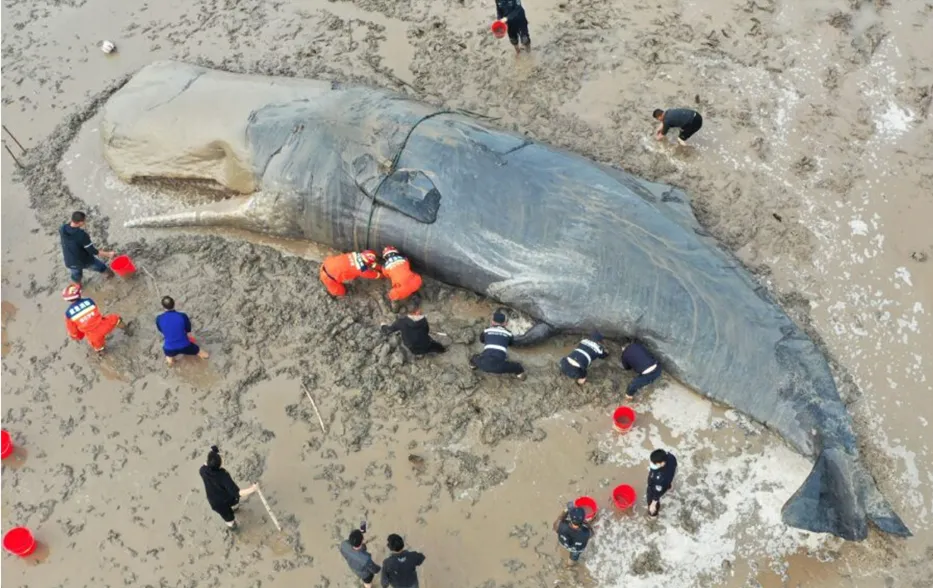
Word spread quickly, and soon, a team of firefighters, volunteers, and marine rescue experts had gathered, united by a shared determination: to save this whale, to give it a chance to return to the life it was meant to live. There was no time for hesitation. The whale’s enormous body thrashed occasionally, a mixture of fear and confusion in its movements, while its enormous tail, which could easily crush a person, left deep impressions in the sand. Everyone knew that even the smallest misstep could mean the difference between life and death.
From the very beginning, the rescue was a race against time. Firefighters sprang into action, spraying hoses of water across the whale’s massive body to keep its skin wet and its temperature regulated. They dug a trench, filling it with seawater, creating a makeshift cradle that allowed the whale to partially support itself while still remaining hydrated. The volunteers worked tirelessly, forming lines along the whale’s sides, ready to assist in moving it as soon as the tide shifted in their favor. The air was heavy with tension, the sound of rushing water and the cries of onlookers blending into a single, urgent rhythm.
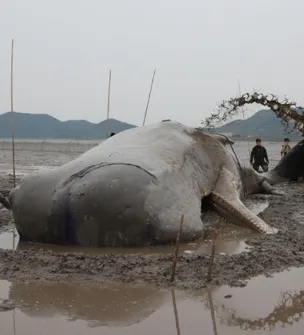
As the hours passed, the whale remained alive, but its energy waned. Every moment was a careful calculation: how to move it safely, how to prevent further injury, how to keep it calm under the immense stress it was experiencing. The rescuers knew that the whale was a living miracle in their hands, a creature of immense intelligence and majesty, deserving every ounce of effort they could give. Some volunteers whispered words of encouragement, while others simply held onto ropes, sweat dripping from their brows, ready to pull, push, and guide as one unified force.
Night fell over Ningbo, and with it came the tide—the key to the whale’s survival. As the water crept higher along the shoreline, the team tied thick ropes around the massive animal, preparing for the final effort. The tension was palpable. Each person knew that this was the moment they had been preparing for: the delicate balance of timing, strength, and coordination that would determine whether the whale returned to its home or succumbed to the cruel grip of fate.
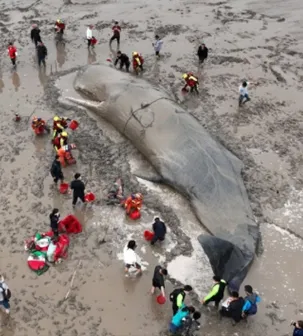
The operation began. Volunteers and rescuers pulled with synchronized effort, while a tugboat waited offshore to help guide the whale into deeper water. Slowly, painstakingly, the giant body inched toward the sea. Each movement was met with a mix of relief and anxiety. The whale’s head tilted toward the water, its massive flippers beating gently against the surf, almost as if it sensed the promise of freedom awaiting it. For nearly twenty-six hours, this extraordinary rescue mission had demanded courage, endurance, and unwavering commitment from everyone involved.
Finally, by dawn, after hours of tense labor, the whale reached a depth where it could float freely. The ropes that had guided it were carefully cut away. For a moment, there was stillness, as if the world itself held its breath. Then, slowly, the whale began to swim. Its enormous tail sliced through the water, propelling it toward the open sea. With each stroke, it gained strength and confidence, finally free from the danger that had threatened its life on the sand.
As the sun rose over the horizon, painting the sky in shades of pink and gold, the whale disappeared into the vast expanse of the ocean. Those who had worked through the long night watched in awe, hearts swelling with quiet joy and relief. Tears glistened in the eyes of volunteers and rescuers alike, not just for the success of the mission, but for the reminder of the resilience of life, the extraordinary bond between humans and the creatures we share the planet with, and the power of determination when a community comes together for a common purpose.
The rescue of this sperm whale was more than just a technical feat; it was a story of hope, compassion, and the unwavering belief that every life matters. It reminded everyone involved that even the largest and most seemingly untouchable creatures can rely on humanity for help in times of need. And it showed that courage and perseverance, even in the face of overwhelming odds, can make miracles happen.
The whale, now back in its rightful element, would continue to roam the ocean’s depths, free to dive, explore, and live as nature intended. Its survival was a triumph not just for the species, but for every individual who had refused to give up, who had worked tirelessly through the night, and who had believed that this magnificent animal deserved another chance at life.
In Ningbo, the story would be remembered as a testament to human compassion, a tale that would inspire countless others to take action when faced with creatures in peril. It is a reminder that even in the most challenging circumstances, with teamwork, dedication, and love, lives can be saved. And in the vast, open sea, the giant sperm whale now swims with the freedom and vitality that it so richly deserves, a living symbol of hope, resilience, and the extraordinary outcomes that can arise when humans and animals meet in trust and care.
The Loneliest Bear: Bruno’s Heartfelt Encounter 730
In a small, quiet mountain town nestled between towering pine trees and rugged peaks, life moved at a slow, peaceful pace. The townspeople had grown accustomed to the presence of a lone grizzly bear, a creature that had become something of a local legend. His name was Bruno, and he had roamed the mountains for years, the solitary figure wandering through the dense forests and valleys. Despite being the only bear spotted within a 100-mile radius, Bruno had earned a reputation for being more curious than dangerous, often seen cautiously approaching the edges of the town, his eyes full of wonder and curiosity, rather than menace.
Bruno’s story had been woven into the fabric of the town’s life, with locals fondly acknowledging his presence as a quiet, solitary reminder of the wild. They knew that he never posed a real threat. But they also understood that, beneath his massive frame and grizzled fur, Bruno was just another creature searching for something more—connection. As a bear in the wilderness, he was an outsider, separated from his kind and wandering alone, without companionship.
For the most part, Bruno kept to himself. He would occasionally visit the edges of town, his huge paws padding softly against the dirt roads as he ventured into backyards, searching for scraps or simply exploring. The locals had come to recognize his familiar tracks and knew to keep their distance. But one weekend, Bruno’s quiet existence took an unexpected turn.
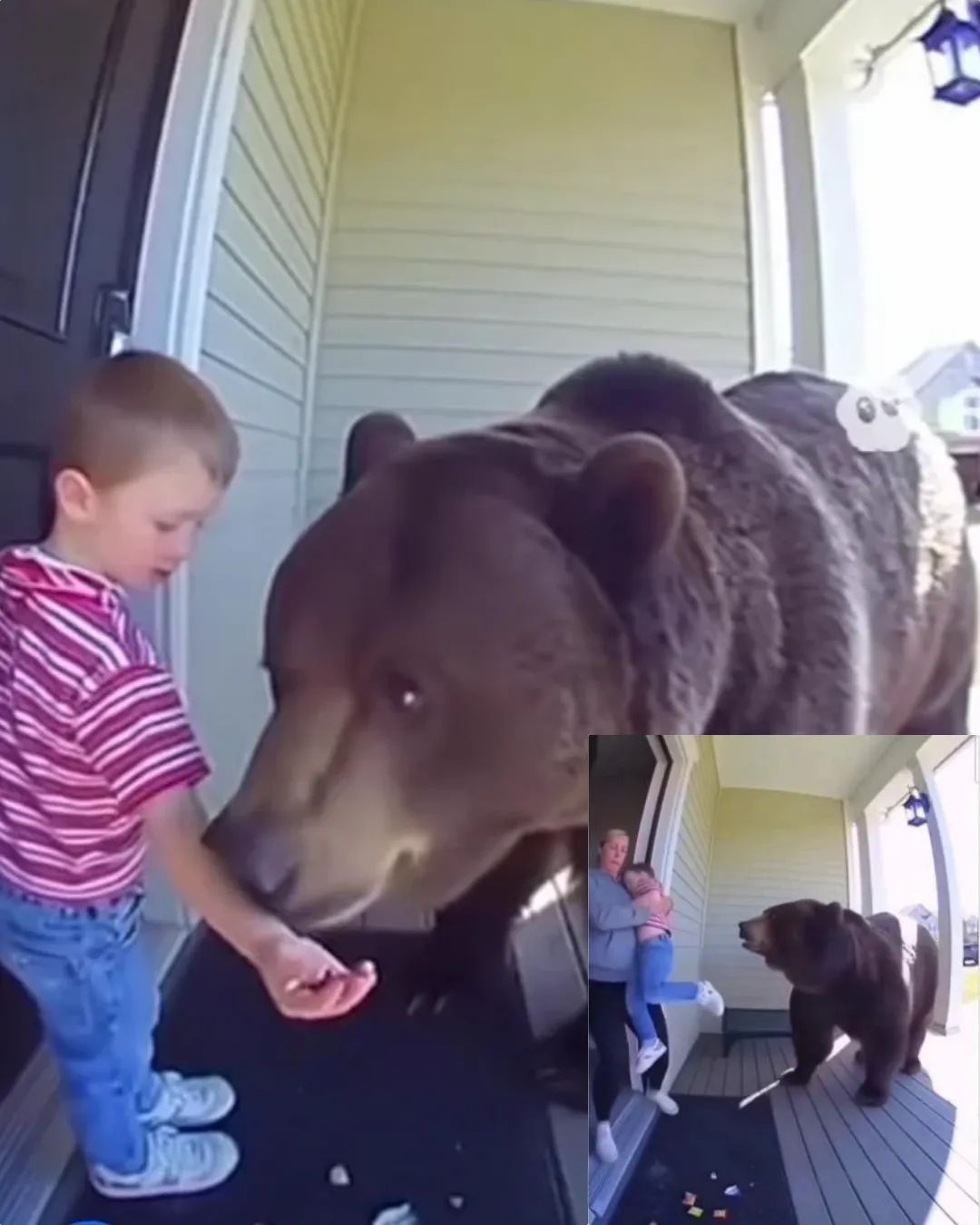
It all started when a young boy, no older than eight, wandered into his yard. The boy had always been fascinated by animals, and that morning, as he played in his yard, he noticed Bruno at the edge of the driveway. The bear was not threatening, nor was he aggressive. He simply stood there, sniffing the air, his dark eyes observing the boy with a gentle curiosity.
The child, unaware of the danger, giggled and crouched down, extending his hand toward the bear, thinking it was a large dog. “Here, boy! Come here, doggie!” the boy called, his voice innocent and filled with excitement. Bruno, intrigued by the sound of the child’s voice, took a tentative step forward. His large head tilted slightly to the side, his enormous paws almost soundless on the earth. Bruno was close now, his nose inches from the boy’s outstretched hand, his breath warm against the chill of the mountain air.
But before the child could make another move, the boy’s mother, who had been inside the house, heard the sound of her son’s voice and the rustling outside. Her heart skipped a beat as she rushed to the door, her eyes locking on the sight of Bruno, only a few feet away from her child. Panic surged through her as she bolted outside, her voice a mix of fear and urgency. “No, no, no! Come back inside now!” she shouted, her arms reaching for her son.
The boy, confused and startled by his mother’s sudden appearance, turned away from the bear and ran back to the safety of his house. His mother, in a frantic state, scooped him up and hurried him inside, locking the door behind them. In the chaos of the moment, Bruno stood still in the driveway, watching them. He did not roar, did not growl or charge. He simply watched as the child disappeared behind the safety of the house. His eyes, usually full of wild energy, now seemed dull and heavy with an emotion no one could have expected from a creature as powerful as he.
For hours, Bruno remained in the driveway. He didn’t move away. He didn’t retreat into the woods, as he had done countless times before. Instead, he sat there, his large form sagging with a kind of quiet sorrow. He wasn’t angry, nor was he frustrated. There was no sign of aggression in his posture. Instead, Bruno appeared deeply saddened, his eyes downcast, his body language deflated. It was as though he had finally found a moment of connection, something he had been seeking for so long, and in the blink of an eye, it was ripped away from him. The bear, who had spent his life alone in the wilderness, had been so close to forming a bond, only to have it vanish as quickly as it had appeared.
The footage of the interaction was captured on a ring camera and, unbeknownst to the family, quickly spread across the internet. Within hours, the video went viral. People from all over the world watched in silence as Bruno sat in the driveway, his eyes filled with what seemed like a quiet, heartbreaking longing. Social media users affectionately dubbed him “the loneliest bear on Earth,” and the footage became a symbol of the quiet, unspoken need for companionship that even the wildest creatures share. Memes and messages of sympathy flooded the internet, with many joking that Bruno only wanted a buddy, not trouble.
As the day wore on, the townspeople began to notice Bruno’s unusual behavior. Normally, he would have moved on after a short time, wandering back into the woods in search of food or shelter. But that day, something was different. Bruno wasn’t leaving. He sat there, the sun dipping low in the sky, casting long shadows over the town. His massive form was a stark contrast against the soft golden hues of the evening light. The loneliness that had defined his existence for so long was palpable. It was a quiet ache, felt deeply by anyone who watched.
Finally, after several hours, the townspeople decided to intervene. The local wildlife officers, who had known Bruno for years, gently approached him. They didn’t want to disturb his peace, but they also knew that the bear needed to move on. He couldn’t stay in the driveway indefinitely, and the townspeople were concerned for his well-being. With calm, patient movements, they coaxed Bruno back toward the woods. The bear, still seemingly lost in his thoughts, slowly stood up, his movements heavy with resignation.
As Bruno turned to leave, he glanced back toward the house one last time. His eyes lingered for just a moment, as though silently saying goodbye to the possibility of friendship. Then, with one final glance, he lumbered off into the mountains, his figure slowly fading into the dense forest. The townspeople, who had watched him for hours, couldn’t help but feel a pang of sadness. Bruno’s loneliness, though fleetingly interrupted by a brief moment of connection, remained a part of him—a part of his journey through a world that, for all its beauty, could be incredibly isolating.
And so, Bruno returned to his life of solitude, a bear in search of something he could never quite grasp—a friend, a companion, someone who might understand the quiet ache in his heart. As the town settled into the night, they carried with them the memory of the bear who only wanted a buddy, not trouble. And perhaps, in the wild expanses of the mountain, Bruno would find what he was seeking one day. Until then, he would wander, the loneliest bear on Earth.