✈️ Overview
| Specification | AH-1Z Viper (USA) | Mi-24 Hind (Russia) |
|---|---|---|
| First Introduced | 2010 (modernized Cobra line) | 1972 (Soviet-era) |
| Primary Role | Dedicated attack helicopter | Attack + troop transport (dual-role gunship) |
| Crew | 2 (pilot + co-pilot/gunner) | 2–3 crew + up to 8 fully armed troops |
| Operational Users | US Marine Corps, allied nations | Over 50 countries (former Soviet bloc and beyond) |
🧠 Design Philosophy: Surgical Strike vs. Flying Tank
🇺🇸 AH-1Z Viper – The High-Tech Precision Predator
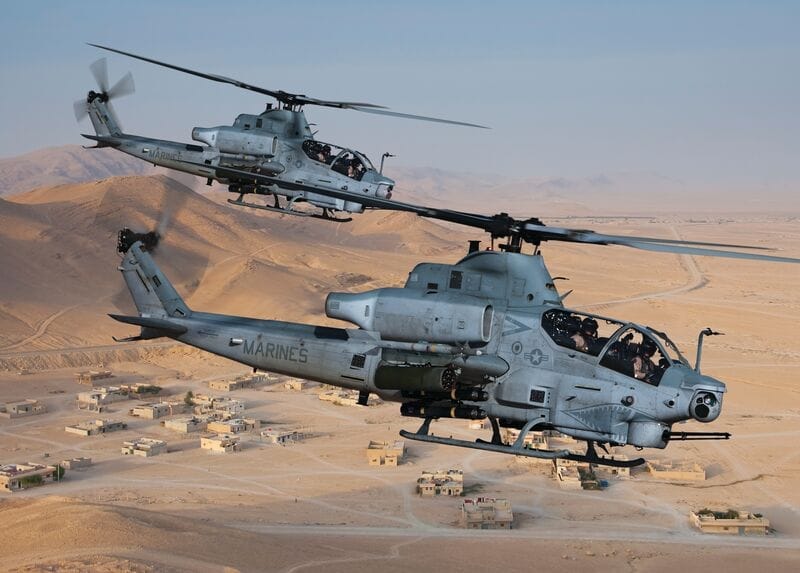
The AH-1Z Viper is the latest evolution of the legendary “Cobra” lineage — the world’s first dedicated attack helicopter. It reflects a Western design doctrine focused on speed, agility, precision strike capabilities, and integration with network-centric warfare.
🔍 Key Features:
-
Sleek, narrow profile for reduced target signature.
-
Upgraded 4-blade composite rotor for greater agility and survivability.
-
Advanced avionics suite: Helmet-Mounted Display (HMD), Target Sight System (TSS), digital glass cockpit, and AESA radar options.
-
Designed to operate in all weather, day and night, with high interoperability in modern joint operations.
💥 Armament:
-
M197 20mm Gatling gun (3-barrel, nose-mounted)
-
AGM-114 Hellfire missiles, APKWS laser-guided rockets
-
AIM-9 Sidewinder, Stinger missiles (air-to-air)
-
70mm unguided rockets, smart bombs (select configurations)
🇷🇺 Mi-24 Hind – The Armored Beast of the Battlefield
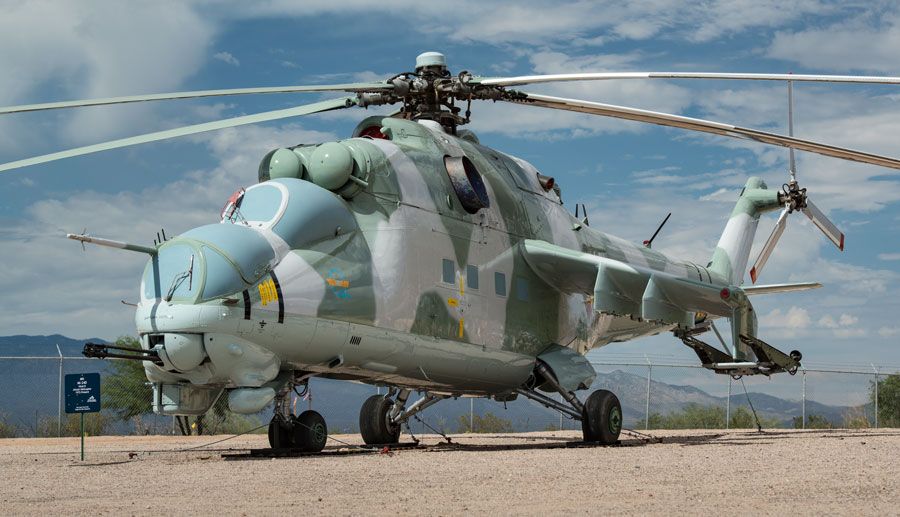
The Mi-24 (NATO codename: “Hind”) is a hallmark of Soviet battlefield doctrine: overwhelming firepower, armor protection, and dual-role functionality as both gunship and troop transport.
🔍 Key Features:
-
Heavy armor protection, capable of withstanding 12.7mm rounds and artillery shrapnel.
-
Built-in troop cabin for up to 8 fully equipped soldiers.
-
Surprisingly fast for a heavy helicopter (~335 km/h), with fixed-wing-like speed.
-
Modern variants (Mi-35M, Mi-24P) feature night vision, FLIR, and improved navigation and fire control systems.
💥 Armament:
-
Twin-barrel GSh-30-2 30mm cannon or YakB 12.7mm Gatling gun (depending on variant)
-
9M114 Shturm / Ataka / Vikhr anti-tank guided missiles
-
57mm / 80mm rocket pods, unguided bombs, gun pods
-
Optional air-to-air missiles in modern upgrades
⚔️ Capability Comparison
| Feature/Capability | AH-1Z Viper | Mi-24 Hind |
|---|---|---|
| Max Speed | ~370 km/h | ~335 km/h |
| Combat Radius | ~240 km (extendable with external tanks) | ~250–300 km (varies by variant and payload) |
| Max Takeoff Weight | ~8,390 kg | ~11,500 kg |
| Payload | ~2,600 kg of ordnance | ~2,400–2,800 kg of ordnance + troop load |
| Armor Protection | Moderate (optimized for agility) | Heavy (designed to survive battlefield fire) |
| Troop Transport | ❌ None | ✅ Up to 8 troops |
| Sensors and Targeting | Top-tier: TSS, HMD, digital architecture | Adequate (modernized in Mi-35M, but still behind) |
| All-weather/Night Ops | ✅ Fully integrated | ✅ With upgrades (Mi-24P, Mi-35M) |
| Exportability | Select partners (e.g., UAE) | Widespread: over 60 countries |
🧩 Tactical Strengths and Weaknesses
🔵 AH-1Z Viper – Strength in Precision and Integration
✅ Strengths:
-
Highly precise strike capability, ideal for urban warfare and counterinsurgency.
-
Designed for close air support (CAS) with real-time coordination with ground forces and UAVs.
-
Lighter and more agile, better suited for hit-and-fade tactics.
-
Fully digital, capable of network-centric warfare with real-time data sharing.
❌ Weaknesses:
-
Lightly armored compared to Mi-24 — vulnerable to heavy machine guns or MANPADS if exposed.
-
Lacks troop transport ability — cannot conduct air assaults or rapid extraction.
🔴 Mi-24 Hind – Resilience and Multi-Role Dominance
✅ Strengths:
-
Dual-purpose: gunship + infantry insertion platform.
-
Thick armor enables high battlefield survivability in high-intensity conflicts.
-
Self-sufficient in harsh environments — effective without sophisticated logistics support.
-
Well-suited for shock assaults, perimeter defense, and rapid troop deployment.
❌ Weaknesses:
-
Bulkier, less maneuverable in complex terrain or tight spaces.
-
Older avionics and targeting systems (unless upgraded).
-
High radar/infrared signature — easier to detect and engage.
🧪 Battlefield Applications
-
AH-1Z Viper excels in precision strike missions, particularly in low-intensity conflicts (e.g., Iraq, Syria, Afghanistan). It thrives when paired with real-time ISR assets and joint-force coordination.
-
Mi-24 Hind is a battlefield tank and workhorse — proven in Afghanistan (Soviet war), Chechnya, Syria, and Ukraine. It shines in high-intensity, armor-heavy, or expeditionary warfare, especially where mobility and firepower need to be combined with infantry transport.
🧠 Strategic Takeaways
| Domain | Advantage |
|---|---|
| Precision & Targeting | AH-1Z Viper |
| Armor & Survivability | Mi-24 Hind |
| Troop Support Capability | Mi-24 Hind |
| Agility & Maneuverability | AH-1Z Viper |
| Avionics & Sensors | AH-1Z Viper |
| Export & Operational History | Mi-24 Hind |
-
The AH-1Z Viper is the embodiment of surgical, high-tech warfare — ideal for modern joint operations, quick strikes, and precision engagement in asymmetric conflicts.
-
The Mi-24 Hind is a flying armored personnel carrier with heavy teeth — engineered for brute-force combat, shock action, and resilience under fire.
Which is “better”?
It depends entirely on the mission profile:
-
For precision air support in a networked environment → AH-1Z Viper
-
For brute-force support and assault insertion in hostile terrain → Mi-24 Hind