COWBOYS’ SEPTEMBER GAUNTLET IS SET: Two NFC East Wars and a Historic Brazil Showdown Will Define Dallas’ Start
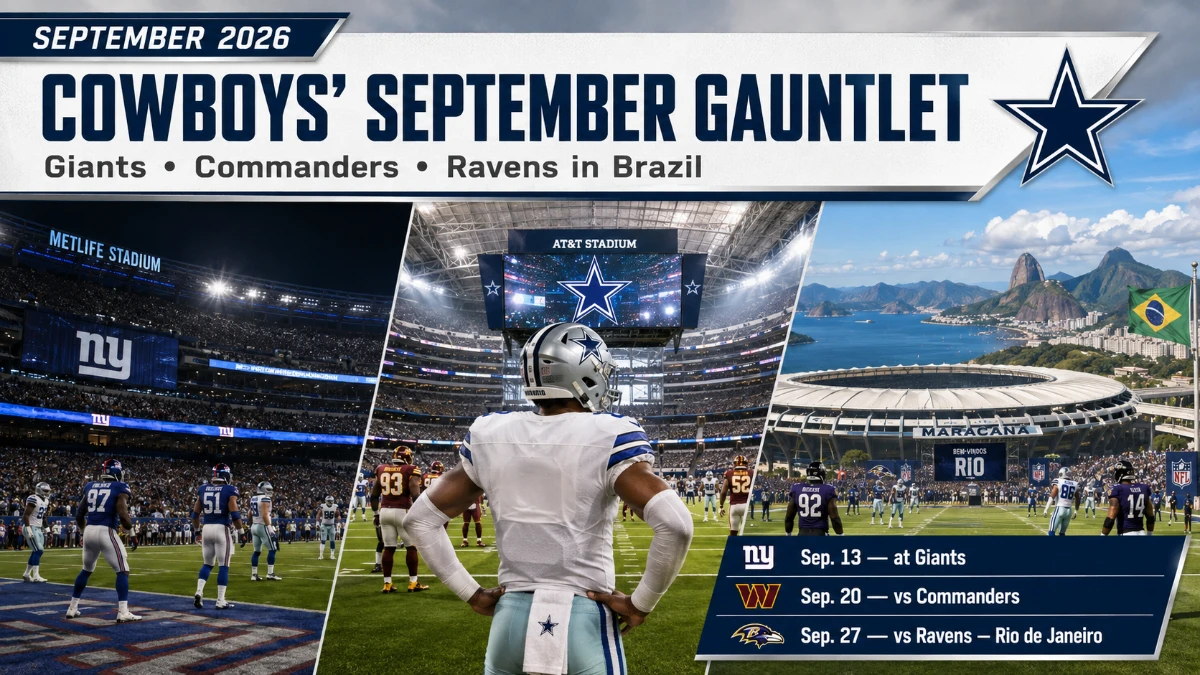
The Dallas Cowboys will not have the luxury of easing into the 2026 NFL season, because their September schedule immediately throws them into two division battles before sending them to South America for one of the biggest international games in league history. Dallas opens on the road against the New York Giants on September 13, returns home to face the Washington Commanders on September 20, and then serves as the designated home team against the Baltimore Ravens at Maracanã Stadium in Rio de Janeiro on September 27. For a franchise coming off a 7-9-1 season and two consecutive years without a playoff appearance, those three games could establish the direction of Brian Schottenheimer’s second season before the calendar even reaches October.
The opening stretch is unusual because Dallas will play three consecutive Sundays but experience three completely different environments, beginning with a prime-time divisional road game and ending thousands of miles from Texas. The Cowboys’ official schedule lists the opener at MetLife Stadium for 7:20 p.m. Central on NBC, the home opener against Washington for 3:25 p.m. Central on FOX, and the Baltimore game in Brazil for 3:25 p.m. Central on CBS. There is no traditional nonconference warmup in that sequence, meaning Dallas will immediately be asked to handle rivalry pressure, an important home divisional game and the logistical challenge of international travel.
Everything begins September 13 against the Giants on Sunday Night Football, and the matchup carries more meaning than the recent history of the rivalry might initially suggest. Dallas has won 15 of its last 17 meetings against New York and 21 of 26 dating back to 2013, although the Giants snapped a nine-game losing streak against the Cowboys in their final meeting of the 2025 season at MetLife Stadium. The Cowboys are also 11-1 all time when opening a season against the Giants, but those numbers will mean little once New York introduces its dramatically changed operation under new head coach John Harbaugh.
Harbaugh’s arrival makes Week 1 substantially more interesting because the former Ravens coach brings 18 years of head-coaching experience to a Giants organization searching for stability. New York also reshaped its roster by adding veterans such as Isaiah Likely, Tremaine Edmunds, Darnell Mooney, Greg Newsome, Daniel Faalele and Patrick Ricard, while several former Baltimore players followed Harbaugh to New York. Dallas therefore will not simply be facing the same Giants team it has routinely controlled in recent seasons, but a new coaching structure that will be attempting to announce immediately that the balance of the rivalry has changed.
The quarterback storyline gives the opener another layer, but the larger strategic challenge for Dallas may come from proving that its rebuilt defense is ready immediately rather than needing several weeks to settle in. The Cowboys finished 7-9-1 in 2025 after a season in which their defense repeatedly failed to support a productive offense, prompting significant coaching and personnel changes during the offseason. A road division game under the Sunday-night spotlight will provide an immediate measurement of whether those changes have corrected the weaknesses that prevented Dallas from returning to the postseason last year.
There is also very little recovery time emotionally because Week 2 brings another NFC East opponent, with the Washington Commanders visiting AT&T Stadium on September 20 for Dallas’ regular-season home opener. Former Cowboys defensive coordinator Dan Quinn will enter his third season as Washington’s head coach, and Dallas’ official schedule notes that Quinn is 1-3 against his former team over the previous two seasons. The Cowboys swept Washington in 2025, including a 44-22 victory in Arlington, but the Commanders spent much of that season navigating major quarterback availability problems involving Jayden Daniels.
Washington’s 2025 collapse also makes the Commanders more dangerous than their 5-12 record might imply, because the previous year they had gone 12-5 and reached the NFC Championship Game during Daniels’ rookie season. Daniels played only sporadically late last year because of injuries, and Washington enters 2026 attempting to restore the identity that made the quarterback one of the league’s most exciting young players before those availability problems changed the season. Blogging The Boys identified protection of Daniels as one of Washington’s central concerns, making Dallas’ ability to generate pressure one of the most important matchups of Week 2.
The Commanders also aggressively rebuilt parts of their defense, adding players including Odafe Oweh, Ahkello Witherspoon, Rasul Douglas, Leo Chenal, Charles Omenihu, Nick Cross and K’Lavon Chaisson while using a top-10 draft selection on linebacker Sonny Styles. Washington allowed explosive passing production throughout 2025 and surrendered only two fewer passing touchdowns than the struggling Dallas defense, so Quinn clearly entered the offseason knowing his unit needed significant change. That creates the possibility of a much different Week 2 matchup than the Cowboys saw last season, particularly if Daniels is healthy and Washington’s new defensive pieces adjust quickly.
Starting the year with consecutive NFC East games places unusual importance on Dallas’ first eight days of regular-season football because an 0-2 opening would also mean an 0-2 division record. The opposite outcome would be extremely valuable, as beating New York and Washington would give the Cowboys two early head-to-head advantages before Philadelphia even appears on their schedule later in October. September therefore is not simply about accumulating wins, because Dallas has an opportunity to establish meaningful divisional leverage almost immediately.
Then comes the game that looks unlike anything else on the Cowboys’ 2026 schedule, as Dallas and Baltimore meet September 27 in the NFL’s first regular-season game in Rio de Janeiro. The matchup will be played at the iconic Maracanã Stadium, which Reuters notes has a capacity of approximately 78,000 and has previously hosted World Cup matches along with the opening and closing ceremonies of the 2016 Olympics. It will also be Dallas’ first regular-season game outside the United States since defeating Jacksonville 31-17 in London in 2014, and the Cowboys enter the event with a 1-0 record in international regular-season games.
The spectacle surrounding Rio will be enormous, but Baltimore may also represent the toughest pure football challenge of Dallas’ opening month. Lamar Jackson remains the centerpiece of a Ravens offense that also features Derrick Henry, while Baltimore replaced longtime coach Harbaugh with former Chargers defensive coordinator Jesse Minter after missing the playoffs in 2025. The Ravens also strengthened their defense with star pass rusher Trey Hendrickson, creating an early test for a Cowboys offense led by Dak Prescott against a team attempting to return immediately to AFC contention.
History offers Dallas another warning because Baltimore has dominated the all-time series, winning six of seven meetings against the Cowboys. The teams last faced each other in Week 3 of the 2024 season, when the Ravens built a 28-6 advantage before surviving a furious Dallas comeback for a 28-25 victory at AT&T Stadium. That result gives the Rio matchup a familiar feel despite the extraordinary setting, with Prescott and Jackson once again headlining a game that could reveal whether Dallas is truly prepared to compete with teams carrying legitimate postseason expectations.
The travel component cannot be dismissed either, especially because Dallas is scheduled to cover roughly 27,980 miles across the entire 2026 season and will make one of its longest journeys almost immediately. The Cowboys are technically surrendering a traditional AT&T Stadium home date to play Baltimore in Brazil, meaning only one of their first three regular-season games will actually take place in Arlington. That makes a successful opening against the Giants and Commanders even more important, because arriving in Rio already chasing the standings would turn an historic event into a high-pressure early-season game.
September will also test Schottenheimer’s ability to manage three completely different types of opponents, from Harbaugh’s redesigned Giants to Quinn’s familiar Commanders and Minter’s rebuilt Ravens. Dallas will have to handle a young divisional quarterback situation in New York, the dual-threat challenge of a healthy Daniels in Washington and then one of the NFL’s most difficult quarterback-running back combinations in Jackson and Henry. For a defense undergoing major changes after its 2025 struggles, there may be no better early measurement of progress than surviving those three contrasting offensive problems.
That is why the Cowboys’ first month should be viewed as far more than three games on a 17-game schedule, because the results could influence everything that follows. Dallas can leave September with division wins, confidence in its rebuilt defense and momentum from a historic international victory, or it can enter October already trying to recover before a difficult stretch that begins at Houston on October 4 and includes Tampa Bay, Green Bay and Philadelphia later that month. For a Cowboys team desperate to end a two-year playoff absence, the 2026 season will begin with only three September games, but those three Sundays could tell everyone very quickly whether Dallas is ready to become a contender again.