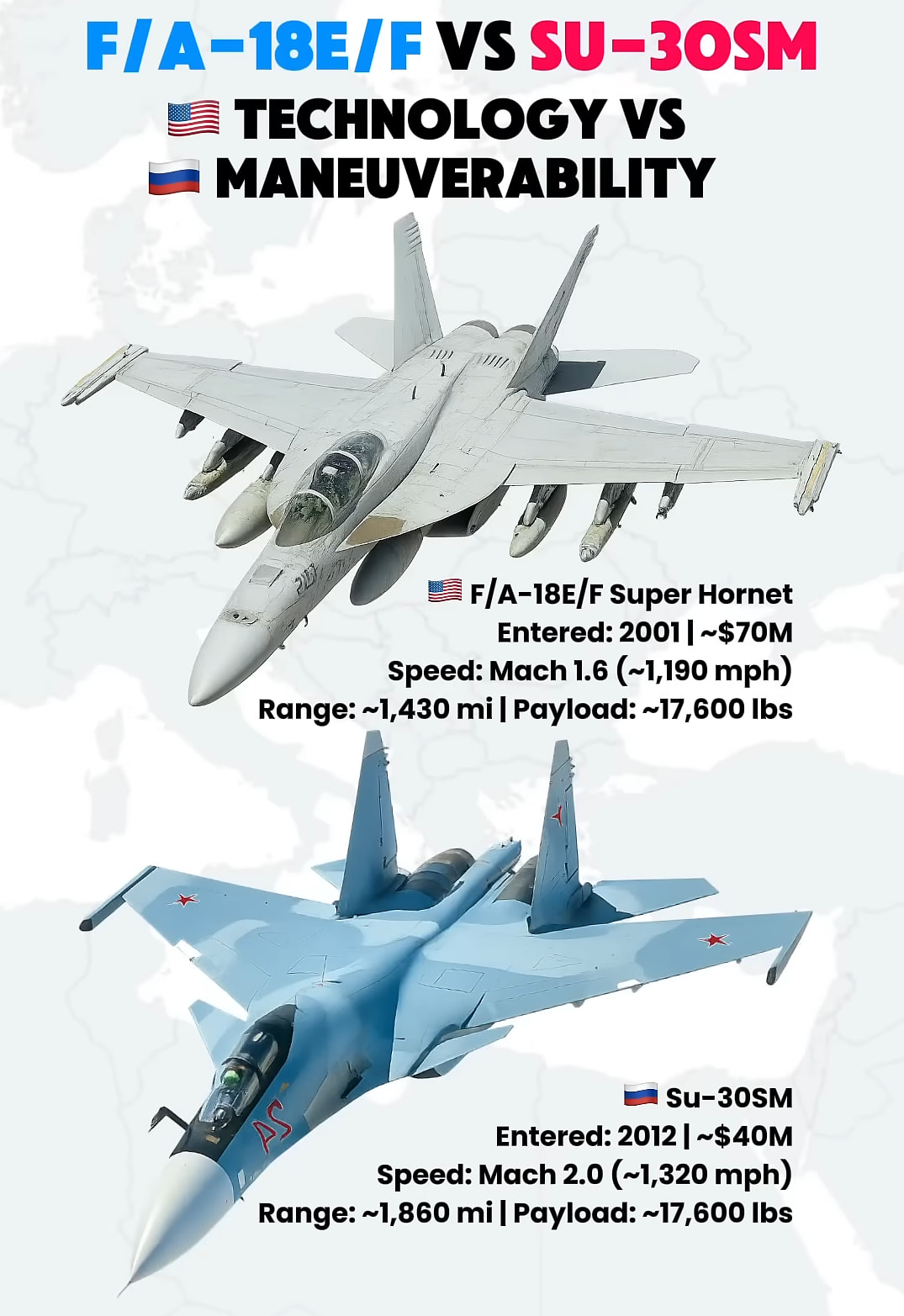
The image compares two prominent fighter jets from the U.S. and Russia, highlighting the distinct design philosophies and combat strengths of each country:
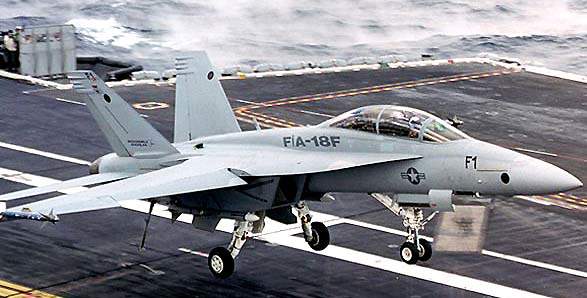
1. F/A-18E/F Super Hornet (USA)
-
Introduced: 2001
-
Estimated Cost: ~$70 million USD
-
Maximum Speed: Mach 1.6 (~1,190 mph)
-
Range: ~1,430 mi
-
Weapon Load: ~17,600 lbs
-
Highlights: The F/A-18E/F represents the “American technology” philosophy, emphasizing electronics, radar, sensors, and battlefield data connectivity. Although its top speed is lower than the Su-30SM, the Super Hornet excels in multirole capabilities, including air-to-air combat, ground attack, and anti-ship operations. Its advanced electronic systems allow pilots to process information quickly and coordinate effectively with other units.
2. Su-30SM (Russia)
-
Introduced: 2012
-
Estimated Cost: ~$40 million USD
-
Maximum Speed: Mach 2.0 (~1,320 mph)
-
Range: ~1,860 mi
-
Weapon Load: ~17,600 lbs
-
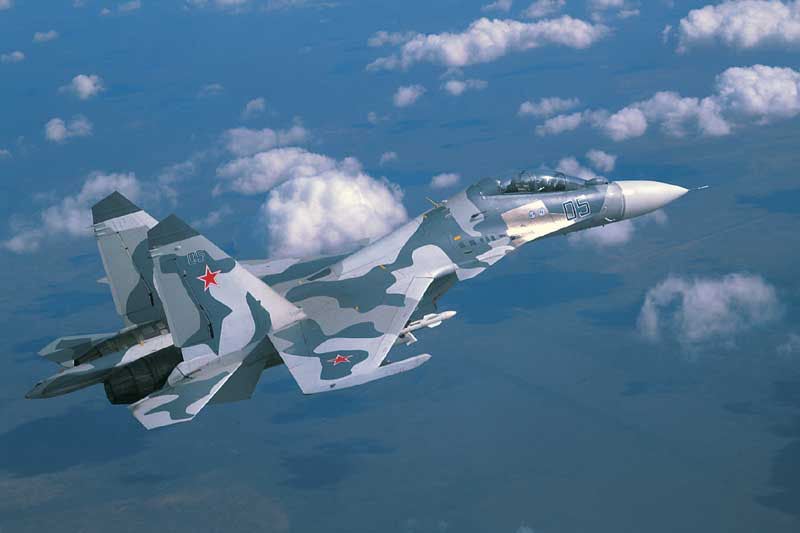
Highlights: The Su-30SM embodies the “Russian maneuverability” philosophy, prioritizing high agility, greater top speed, and long-range capability. It features thrust-vectoring engines, enabling complex maneuvers and superior performance in dogfights. Despite a lower price than the F/A-18E/F, it carries a similar weapon load, making it a cost-effective choice for air forces.
3. Overall Comparison
-
Technology vs. Maneuverability: The U.S. focuses on technology and electronics, while Russia emphasizes agility and speed.
-
Range and Speed: The Su-30SM has an advantage in maximum speed and range, benefiting long-range combat.
-
Cost: The Su-30SM is nearly $30 million cheaper than the Super Hornet, offering greater economic efficiency for buyers.
-
Combat Philosophy: The F/A-18E/F prioritizes multirole combat and coordination, whereas the Su-30SM prioritizes flexibility and dominance in dogfights.
Conclusion:
These two fighters reflect different military strategies: the U.S. relies on technology and data integration, while Russia prioritizes maneuverability and direct aircraft power. In a hypothetical confrontation, the outcome would depend heavily on combat context, pilot tactics, and the support of accompanying forces.