
Getty
Brandon Aubrey is eligible for a contract extension from the Cowboys.
Much is being made of the Dallas Cowboys‘ attempts to re-sign 1A wide receiver George Pickens, but some may have forgotten that kicker Brandon Aubrey is also up for a new contract this offseason.
ESPN’s Dan Graziano put together the options for Dallas to re-up the superstar kicker and suggested he will be back with the Cowboys on a four-year contract with more than $12 million guaranteed.
Aubrey, of course, has become a weapon for the Cowboys since he joined them in 2023. The undrafted 30-year-old has made 88.2% of his field goals and missed only four of 130 career extra points, qualifying for the Pro Bowl in each of his three seasons.
The Cowboys Have Options When It Comes To Re-Signing Brandon Aubrey
Graziano presented the most logical decision would be to simply make Aubrey the highest-kicker in the NFL. Harrison Butker of the Kansas City Chiefs holds the most valuable kicker contract, and he is signed through the 2028 season with $17.75 million in guaranteed money.
Still, the negotiating tactics that Jerry Jones, Stephen Jones and the Cowboys have employed previously is why Graziano was more conservative with his extension estimate, especially with Aubrey a restricted free agent.
“The Cowboys have a lot of options if they decide they don’t want to make Aubrey the highest-paid kicker in the NFL. Of course, they could decide to do just that,” Graziano wrote. “But these Cowboys contract extension conversations have a way of getting complicated, and we shouldn’t assume an open-and-shut deal here.
“The Cowboys have so much leverage and have shown in previous negotiations with their own players that they aren’t afraid to use it.”
Aubrey’s contract was perhaps the best bargain in the NFL, since he kicked for about $886,000 the past three seasons. So he is in line for a raise either way, and Graziano explained Dallas’ tender options.
“If the Cowboys don’t want to extend Aubrey, they could offer him a one-year restricted free agent tender,” Graziano wrote. “The options would be a first-round tender (likely around $7.8 million), a second-round tender (likely around $5.7 million) or a right-of-first-refusal tender (likely around $3.5 million).
“If they use the first-round tender, another team offers Aubrey a contract and the Cowboys decline to match the offer, the team that signs Aubrey would have to give the Cowboys a first-round pick. If they use the second-round tender and the same thing happens, the team that signs Aubrey would have to give the Cowboys a second-round pick.”
Those sound like compelling deals that would block potential rivals from poaching him. But Graziano spelled out what could happen if Dallas picks the right-of-first-refusal tender.
“But if they use the right-of-first-refusal tender and the same thing happens, the team signing Aubrey wouldn’t have to give the Cowboys any compensation at all,” Graziano wrote.
The Cowboys Can Also Use The Franchise Tag On Brandon Aubrey
Many feel the Cowboys are saving their franchise tag to lock in Pickens if they can’t get him signed long-term. But Graziano explained why Aubrey could earn the tag if Dallas does figure out a long-term deal with the wide receiver.
“What’s interesting here is that the kicker franchise tag projects to be around $6.7 million, which means it would be cheaper to franchise Aubrey than tender him at the first-round level,” Graziano wrote.
The Cowboys and the Super Bowl used to be a thing
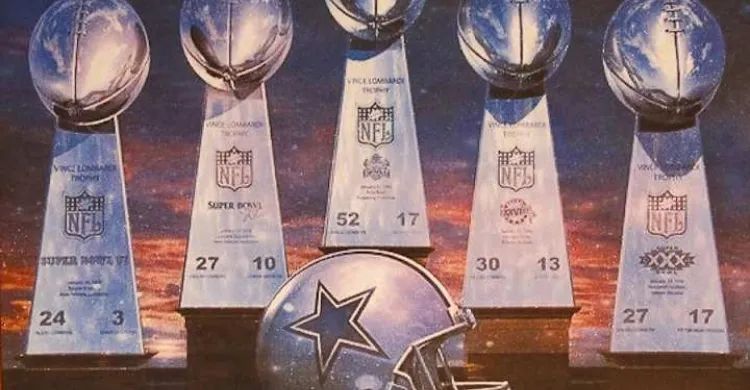
As this year’s teams prepare to meet in Santa Clara for Super Bowl LX the Dallas Cowboys will be at home, watching the championship game, for the 30
th straight year.

We call that a drought here. We still don’t know what Stephen Jones would call it.
Over the first 30 years of Super Bowl history, the Cowboys were almost synonymous with the NFL’s championship game.
Dallas represented the NFC five times out of the first 13 Super Bowls. They were in eight of the first 30 championship games.
Dallas appeared in a total of 16 NFC Championship games, including twice when it was the NFL Championship game prior to the NFL-AFL merger, between 1966-1995.
By the end of the 1995 season, the Cowboys were 5-3 in the Super Bowl and had won the last three times they played for the title. They were 8-8 in conference title games.
Thirty years later, those records remain unchanged.
Let’s review the Cowboys’ Super Bowl history.
Super Bowl V
Jan. 17, 1971 – Baltimore Colts 16, Dallas Cowboys 13
After four years of playoff frustration – losing twice in the NFL Championship game to the Packers and back-to-back divisional losses to the Browns – to close out the 1960s, the Cowboys had finally broken through.
In 1970, the first year the NFL and AFL teams were playing in the same league, Dallas finally seemed to be ready to reach the summit. The beat the 49ers in the NFC title game and faced the Colts for the NFL championship.
It was an ugly game at the Orange Bowl.
The Colts had seven of the game’s 11 total turnovers.
The Cowboys were flagged 10 times for 133 yards against Baltimore’s four for 31.
Jim O’Brien’s 32-yard field goal as time expired gave the Colts a 16-13 victory. Chuck Howley was named MVP thanks to his two interceptions.
He remains the only player from the losing team to earn a Super Bowl’s MVP award.
Super Bowl VI
Jan. 16, 1972 – Dallas Cowboys 24, Miami Dolphins 3
The Cowboys rebounded the following year. After again dispatching the 49ers in the conference championship game, Dallas throttled the Miami Dolphins in New Orleans.
The highlight of the game was Bob Lilly’s 29-yard sack of Bob Griese.
Despite the defense’s dominating performance, Roger Staubach was named MVP.
Super Bowl X
Jan. 18, 1976 – Pittsburgh Steelers 21, Dallas Cowboys 17
The Cowboys were coming off the Hail Mary win over the Vikings in the divisional round and a dominating 30-point win over the Rams in the NFC title game.
But the Steelers, and an incredible game from Lynn Swann, proved to be too much. Dallas would lose in a Super Bowl for the second time in Miami.
Super Bowl XII
Jan. 15, 1978 – Dallas Cowboys 27, Denver Broncos 10
Back in New Orleans, the Cowboys secured their second Super Bowl overall. In this game, the defense again dominated.
This time, the defense was recognized.
The defense forced eight turnovers, four interceptions and four fumbles. They sacked Broncos quarterbacks four times in the win.
In the first, and so far only, time the MVP was split between two players – Harvey Martin and Randy White.
Super Bowl XIII
Jan. 21, 1979 – Pittsburgh Steelers 35, Dallas Cowboys 31
One year later, the Cowboys were back to defend their title, and gain revenge for their loss in Super Bowl X to the Steelers.
In an eerie repeat of the 1975 run, Dallas had narrowly escaped with a divisional round win. This time a come-from-behind 27-20 win over the Falcons.
The Cowboys crushed the Rams 28-0 in NFC championship game and then headed back to Miami for the rematch with Pittsburgh.
Apparently, the Cowboys can’t win postseason games in Miami.
They can only lose them in heartbreaking fashion. The most iconic play of the game was Jackie Smith’s dropped pass in the endzone.
Dallas still got three points, but the four left on the turf on that play was the margin of defeat for the Cowboys.
At 0-3 in Super Bowls in Miami, Dallas lost them by a combined 11 points.
Super Bowl XXVII
Jan. 31, 1993 – Dallas Cowboys 52, Buffalo Bills 17
A 14-year drought for Super Bowl appearances finally came to an end as the 1992 season concluded. The Cowboys would lose in the NFC Championship game three times during this drought.
All three came in consecutive seasons, 1980-1982.
Once again, they advance to the Super Bowl following an NFC title game win over the 49ers to face the Buffalo Bills in Pasadena, CA.
This game was dominated by the Cowboys’ defense. By the time it was over, Dallas was now 3-3 in Super Bowls after a 35-point rout.
Super Bowl XXVIII
Jan. 30, 1994 – Dallas Cowboys 30, Buffalo Bills 13
At times, the 1993 season seemed like a replay of the previous year. The Cowboys again dispatched the 49ers in the conference title game.
And again, this time in Atlanta, they would face the Bills in the Super Bowl.
This time around, Buffalo put up more of a fight.
But a key fumble by Thurman Thomas turned the game around. The Cowboys defended their crown.
Within days, Jerry Jones’s ego would derail the Cowboys drive to three-peat.
Super Bowl XXX
Jan. 28, 1996 – Dallas Cowboys 27, Pittsburgh Steelers 17
Dallas had survived a shootout with the Packers in the conference championship to advance to their eighth Super Bowl. This time, they’d play in Tempe, AZ.
Waiting for them was a nemesis from 20 years before – the Steelers.
Only this time, the Cowboys were the better team when the gun sounded. It didn’t hurt that Neil O’Donnell made Larry Brown look like Deion Sanders by throwing two gift interceptions right to him.