The Madagascar Blue Vanga is now included in the endemic bird species of Madagascar since it became a full species separated from C. comorensis. It frequents the woodlands of the island, and exceptionally mangroves in the west. Like other vangas, it feeds primarily on insects, but it regularly takes some berries too.
The Madagascar Blue Vanga is common throughout its range, and the species is not currently threatened.
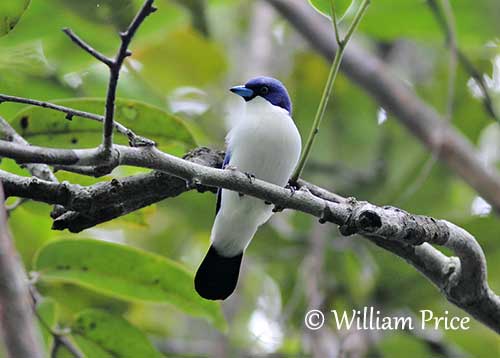
The female resembles male but she is duller. On the white underparts, the breast shows sometimes a light pale orange wash.
The juvenile has mostly grey-blue head and upperparts. The eyes are brown and the bill is black.
RANGE:
The Madagascar Blue Vanga is common throughout the island, except on central plateau and drier south.

HABITAT:
The Madagascar Blue Vanga frequents a variety of woodland including the deciduous dry forest in the west, and the rainforest in the east of the island. It may be found in adjacent second growth, and occasionally in mangroves in W Madagascar.
The species is visible from sea-level up to 1,200 metres of elevation, and sometimes up to 1,600 metres in areas with large trees.

The Madagascar Blue Vanga gives repeated, harsh « teea teea teea » and a short, medium-pitched “scheet” used as alarm calls. It also utters a hard rattle “tcccccccch” also given repeatedly “chrr-crrk-crrk-crrrk-crk-crk”.
This “song” is sometimes given from tree top, and can be either slow or fast, with the first note usually higher-pitched.
BEHAVIOUR IN THE WILD:
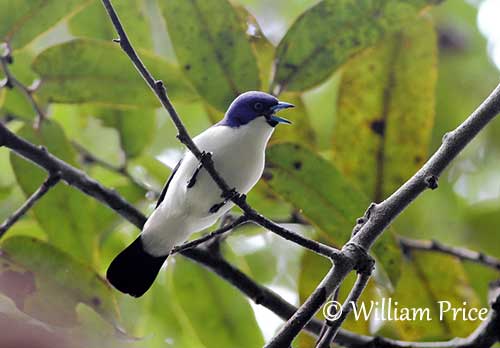
The Madagascar Blue Vanga feeds primarily on insects such as Coleopterans and Orthopterans, and caterpillars. It is one of the few vanga species known to take regularly berries too.
This small, agile bird often hangs upside-down while foraging in middle and upper levels of trees. It forages in leaf clusters almost at the end of thin branches.
The Madagascar Blue Vanga forages in groups of up to 6 individuals, usually mixed-species flocks outside breeding season. But when nesting, it can be seen in pairs.

Information is not currently available about the breeding behaviour and the displays of this species.
The Madagascar Blue Vanga is sedentary in its range.
Like other vangas, this species has short, rounded wings, and only performs short distance flights.
REPRODUCTION OF THIS SPECIES:

The breeding season probably occurs at least in October/November.
Only one nest was found and described, a cup-shaped structure made by both mates with fine twigs and a pale-coloured lining inside. This nest was placed near fork in tree, about 12 metres above the ground.

The female lays pale bluish/greenish eggs with darker speckles. From an observation, a dependent juvenile fed by the male was observed in November. No other information.
