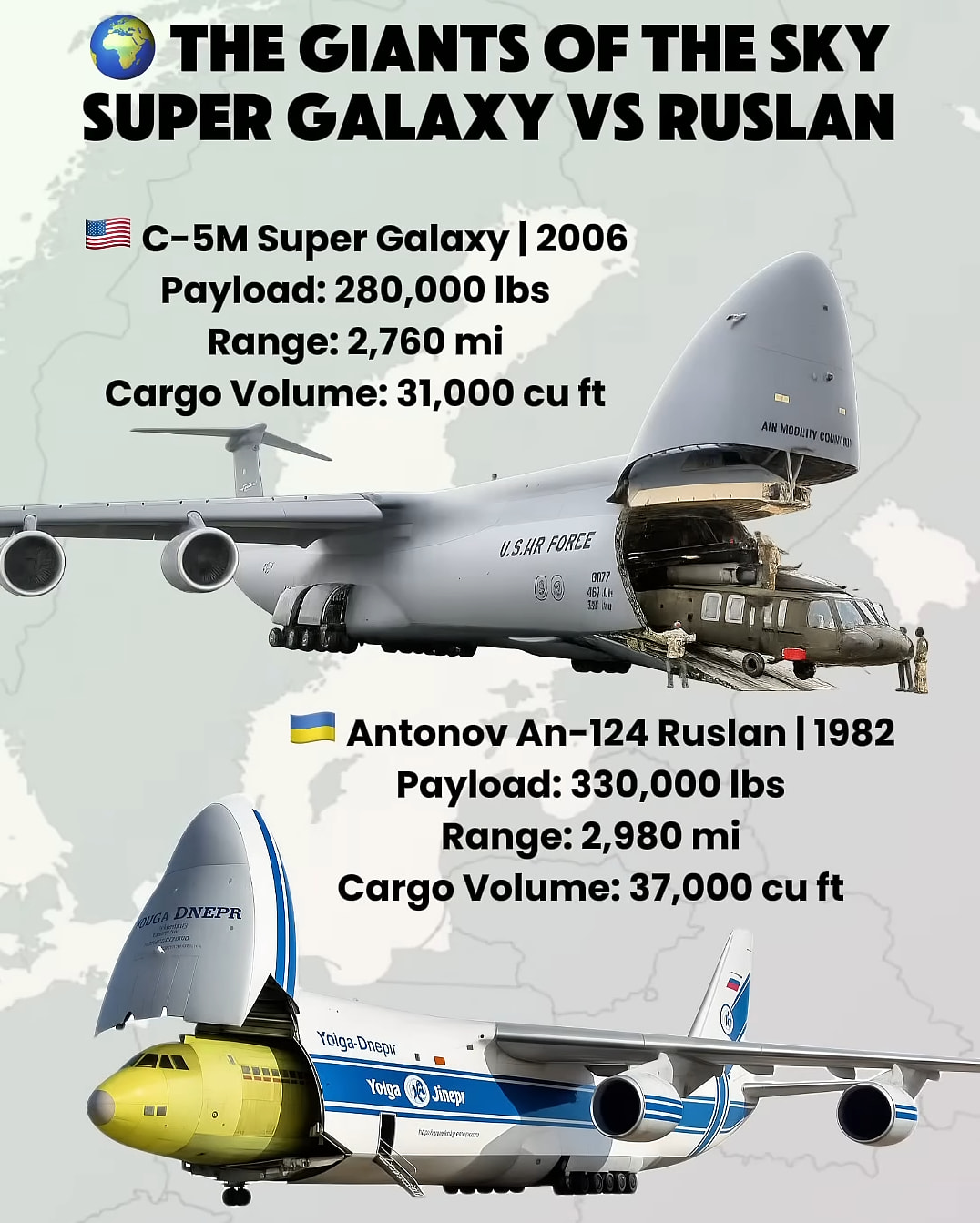
In the world of heavy military and civilian air transport, only a few aircraft can truly be called “giants of the sky.” Two of the most prominent names are the United States’ C-5M Super Galaxy and Ukraine/Russia’s Antonov An-124 Ruslan. Although developed in different decades and serving different industries, both stand as icons of technical power and extraordinary transport capability.
1. C-5M Super Galaxy: A Marvel of the U.S. Air Force

-
Year introduced: 2006
-
Maximum payload: 280,000 lbs (~127 tons)
-
Range: 2,760 mi (~4,440 km)
-
Cargo hold volume: 31,000 cu ft (~877 m³)
The C-5M Super Galaxy is the modernized version of the C-5 Galaxy series, originally developed by the U.S. Air Force in the 1960s. With its enormous cargo hold and a nose that lifts upward, the C-5M can transport armored vehicles, helicopters, or oversized cargo that few other aircraft in the world can handle.
The strengths of the C-5M lie in its upgraded engines and avionics systems, which improve fuel efficiency, takeoff and landing performance on shorter runways. These upgrades help the C-5M maintain its position as the backbone of the U.S. strategic airlift capability.
2. Antonov An-124 Ruslan: The Eastern European Heavyweight
-
Year introduced: 1982
-
Maximum payload: 330,000 lbs (~150 tons)
-
Range: 2,980 mi (~4,800 km)
-
Cargo hold volume: 37,000 cu ft (~1,050 m³)
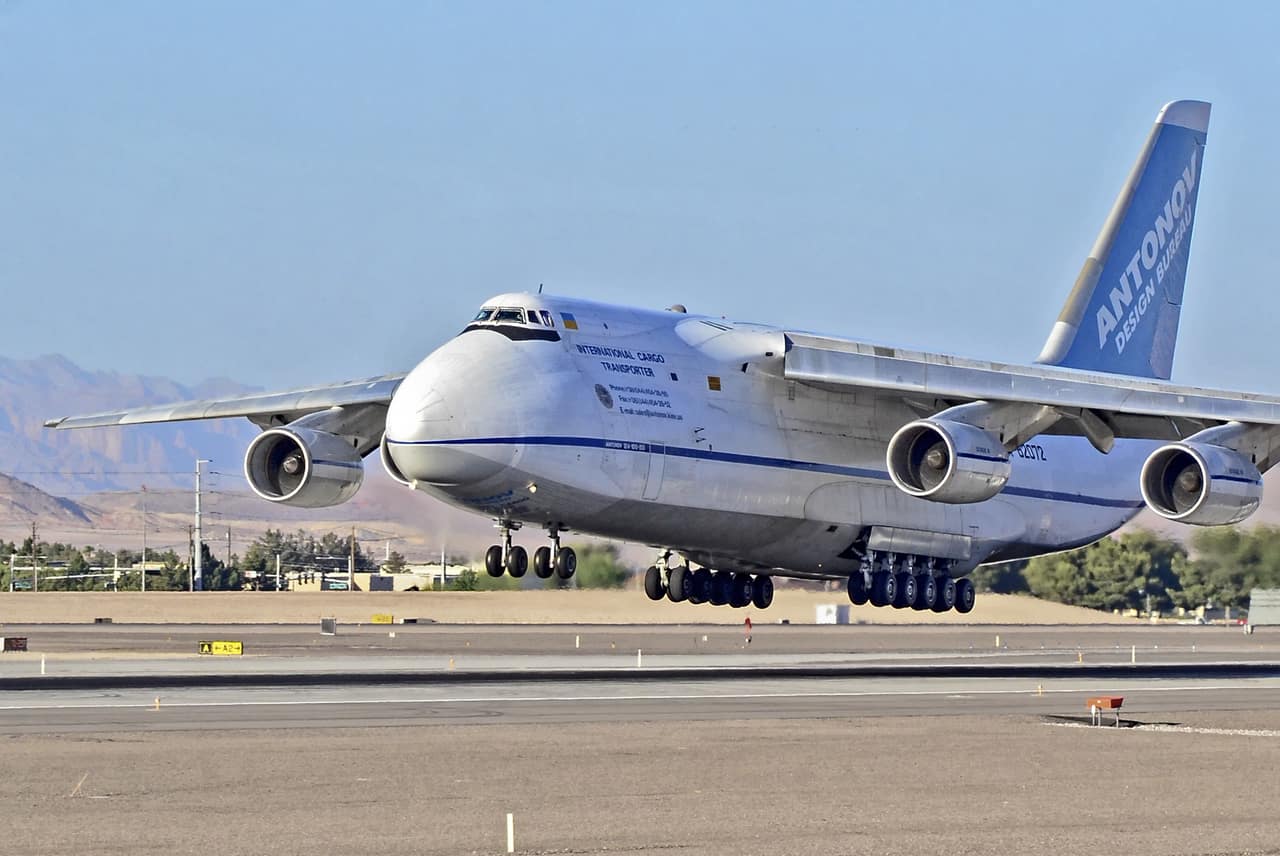
Developed by Antonov in the Soviet Union, the Antonov An-124 Ruslan was the world’s leading heavy transport aircraft before the C-5M emerged. With a higher maximum payload and a larger cargo hold than the C-5M, the An-124 can carry ultra-heavy cargo, ranging from military equipment to large turbine engines.
A notable advantage of the An-124 is its nose-opening design and hydraulic cargo floor, allowing for easy loading and unloading of oversized cargo, especially in military or humanitarian operations. This has made the An-124 a popular choice for international commercial transport contracts.
3. Power and Transport Capability Comparison
| Criteria | C-5M Super Galaxy | Antonov An-124 Ruslan |
|---|---|---|
| Maximum payload | 280,000 lbs | 330,000 lbs |
| Range | 2,760 mi | 2,980 mi |
| Cargo hold volume | 31,000 cu ft | 37,000 cu ft |
| Year introduced | 2006 | 1982 |
| Strengths | Modern avionics, short runway takeoff/landing capability | Large cargo hold, hydraulic cargo floor, superior payload |
Observation: Each aircraft has its own advantages: the C-5M emphasizes modern technology and strategic efficiency, while the An-124 stands out for its massive and flexible transport capacity. This difference reflects the distinct approaches of Western and Eastern European countries in developing heavy transport aircraft.
4. Strategic Role
Both “giants” serve not just as transport tools, but as strategic assets. They enable countries to deploy forces, equipment, and humanitarian aid on a global scale. In peacetime, they carry large volumes of commercial cargo; in war or crisis, they become indispensable logistics backbones.
Conclusion
The C-5M Super Galaxy and Antonov An-124 Ruslan are vivid testaments to human engineering prowess in aviation. Despite differences in payload, range, or technology, both prove that a “giant of the sky” is measured not only by size, but by the ability to turn seemingly impossible missions into reality.