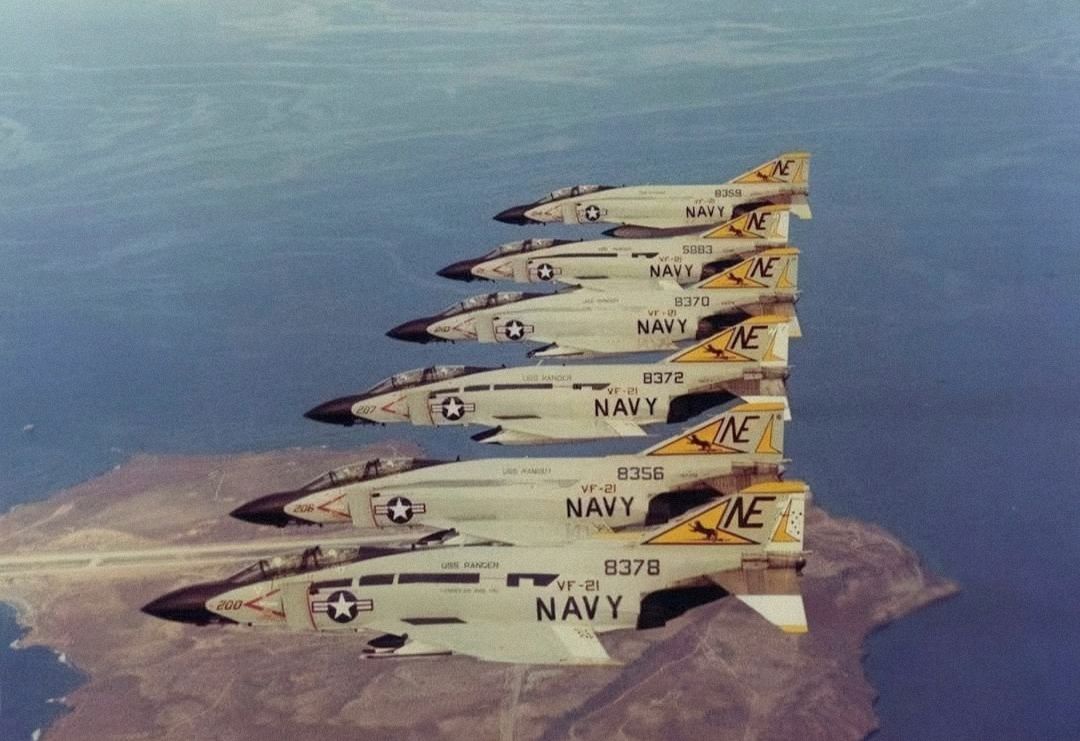
The U.S. Navy’s Fighter Squadron 21 (VF-21), famously known as the “Freelancers,” played a pivotal role in American air operations during the Cold War and Vietnam War era. From the early 1960s through the 1970s, VF-21 operated the McDonnell Douglas F-4 Phantom II, one of the most versatile and iconic jet fighters of its time.
Operating primarily from carriers such as the USS Ranger and USS Hancock, the squadron was deeply involved in multiple combat cruises during the Vietnam War. Its missions covered a wide spectrum: providing fleet air defense, escorting strike packages, conducting aerial interceptions, and carrying out ground-attack operations. The Phantom’s robust design and multi-role flexibility made it an ideal platform for the Navy during this period of intense conflict.
The squadron’s F-4s were armed with advanced missile technology for the era, particularly the AIM-7 Sparrow and AIM-9 Sidewinder. These weapons gave VF-21 a critical edge in long-range and close-range air-to-air combat, enhancing its ability to defend carrier strike groups against enemy aircraft. In this sense, VF-21 embodied the Navy’s evolving doctrine of missile-based aerial warfare, moving beyond the gun-centric dogfights of earlier decades.
By the mid-1970s, VF-21 transitioned from the Phantom to the Grumman F-14 Tomcat, a leap forward in both capability and technology. The F-14 brought with it the long-range AIM-54 Phoenix missile system, variable-geometry wings, and more advanced radar, ensuring that the Freelancers remained at the forefront of fleet air defense.
Ultimately, VF-21 was disestablished in 1996, but its legacy is closely tied to the era of the Phantom II and Tomcat—two aircraft that defined U.S. naval aviation during the Cold War. The squadron’s history reflects not only the technological evolution of naval fighters but also the strategic demands placed on carrier aviation during one of the most turbulent periods in modern military history.