Hudson Dick, a bright and energetic 9-year-old from Fort Lauderdale, was a typical young boy—full of life, schoolwork, and soccer. But in October 2023, everything changed when Hudson suddenly began complaining of a severe headache. To most parents, this would be a concern, but to Kristin Dick, it was the beginning of an unimaginable ordeal.
“When I was talking to him, he started presenting with stroke-like symptoms and weakness on the left side,” said Kristin. “For Hudson to have woken up and told us that his head was hurting so badly was a big deal.” With mounting concern, Kristin immediately called 911, and Hudson was rushed to the nearest hospital.
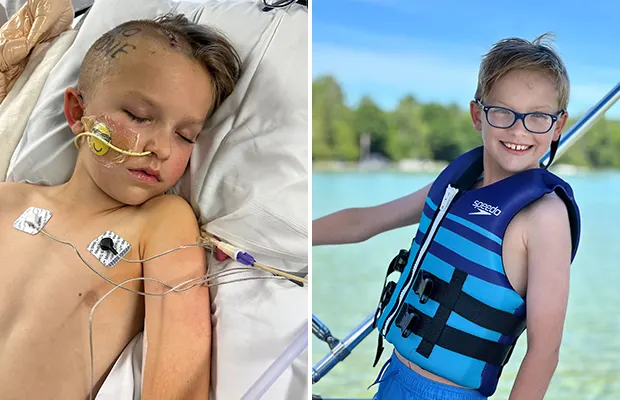
The family’s worst fears were soon confirmed. Hudson had a brain arteriovenous malformation (AVM)—a rare condition where a tangle of abnormal blood vessels in the brain forms. The AVM, which measured 5 ½ centimeters, had ruptured, causing a brain bleed and stroke. As the bleeding continued, it pressed on Hudson’s brain, leading to a herniation, a blown pupil, and eventually, a coma.
The medical team acted quickly, performing a craniectomy, a brain surgery that involves removing part of the skull to relieve pressure on the brain. Hudson’s family held onto hope as he was stabilized, but they knew that they needed more specialized care to help their son.
After many conversations with medical experts and friends, Hudson was transferred to Holtz Children’s Hospital at Jackson Memorial Medical Center, one of the few centers in South Florida with expertise in treating AVM for both children and adults. Here, Hudson would receive the care he desperately needed.
“At first, Hudson wasn’t speaking, and he couldn’t move the left side of his face and body,” recalled Dr. Robert M. Starke, co-director of endovascular neurosurgery at Jackson Memorial Hospital. “Since his AVM was so large and near critical areas in his brain, the best approach was embolization, where we block the blood vessels feeding the AVM. Afterward, we were able to completely remove the AVM, which was a tremendous success.”
Though Hudson was initially unable to speak or move, the family never gave up hope. The road to recovery, however, would be long. Dr. Heather J. McCrea, director of pediatric neurosurgery at Holtz Children’s, explained, “Hudson had substantial deficits from his initial bleed—he had to relearn everything. But he’s an incredibly motivated kid, and he did remarkably well.”
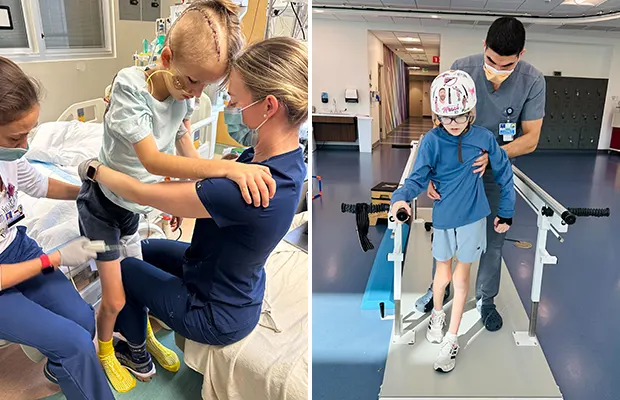
For Hudson, the road to recovery included not just medical treatment, but physical therapy. He spent a month in the pediatric intensive care unit at Holtz Children’s, where he worked on his mobility and motor function with Kyle Zreibe, a physical therapist at the Christine E. Lynn Rehabilitation Center for The Miami Project to Cure Paralysis. Zreibe described their first meeting, “When I first met Hudson, it was immediately after surgery. Our first task was to assess his movements. He required a lot of help just to sit on the edge of the bed.”
But Hudson, ever the determined young athlete, didn’t let the challenges hold him back. “Walking was really hard for me,” Hudson admitted. “I didn’t have good balance at the time either. But just standing for a while was good, and my left leg started getting used to standing and walking.”
With the support of his team, Hudson’s progress was nothing short of remarkable. “By December, he was already walking on his own without any body weight or support,” said Zreibe. “Hudson’s a huge soccer fan, and he’s very motivated by Lionel Messi. I would always tell him that therapy was like training camp for the Inter Miami soccer team, and that helped normalize the process.”
By the time the holidays arrived, Hudson was ready to go home. He had made extraordinary strides in his recovery, and by January, he was back at school. Incredibly, despite missing ten weeks of class, Hudson made the Honor Roll by the end of the school year.
Kristin, his mother, reflected on the journey: “My husband and I feel like Hudson is a miracle kid. The stars aligned to save Hudson’s life, and we’re so proud of him. We truly believe that we wouldn’t be where we are today if it weren’t for Jackson and the exceptional care he received.”
Hudson himself, with his usual optimism, said, “I think God kept me around for a good reason. One day, I’ll do something great.”
Hudson’s story is one of incredible resilience, not only from a medical standpoint but also from the spirit of a young boy who faced the unimaginable and emerged stronger. With the support of his family, doctors, and therapists, Hudson is on a path to reclaim the life he once knew—and maybe even achieve something great.